
We are sure that you, like many thousands before you, will find that our city is beautiful, a visit can be relaxing or exciting or some of both, and the people are friendly and eager to meet you.
If you were here before the Covid pandemic, you'll also notice something else. We have far fewer young people than before. During the pandemic, everything closed. Young people went back to their rural villages. Many married, or became essential to the family farm, and stayed there. Entry-level salaries in the towns are too low to bring them back. And in school, even in college, they didn't acquire the basic skills to qualify for a better job.
Everyone agrees that school quality is extremely poor. A 2019 assessment by UNICEF and the Ministry of Education and Sports found that half of children in grade 5 (about age 10) could not read a simple Lao text. A World Bank report shows only Zambia ranking lower. Nor does rote schooling prepare young people for jobs that require problem-solving, initiative, and teamwork.
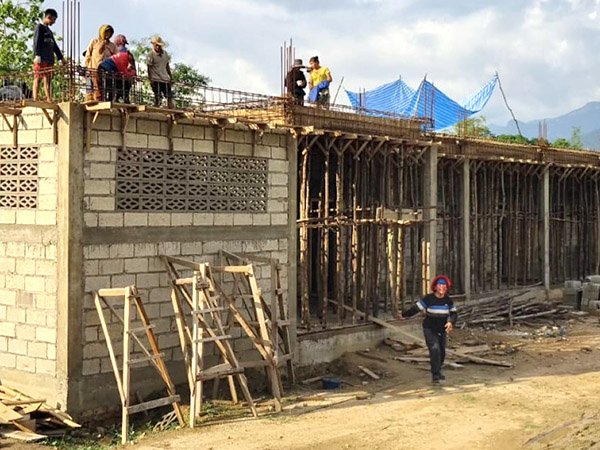
Big Brother Mouse is changing that. We opened our first school in 2016. Now thousands of children in our schools are learning to read in grade 1, sometimes in kindergarten, and to enjoy it. They also acquire good math and other academic skills, as well as the broader skills that are crucial in life, but often overlooked.
One more thing: They're having fun as they do it. That's no coincidence. Happy, active children are sponges for learning. We create the opportunity.
And you can a part of all this. You can leave more than just footprints, and take home more than just photos. Doing so will enrich your trip – and many lives.
 Learn more. What's that unfamiliar object you see in the market? How do you cook these vegetables? Our book What's in the Market? answers these questions and more. Other books tell the parables that are illustrated by mosaics at Wat Xieng Thong, and describe the lives of the little-known Forest People of Laos. Young Laotians from the Hmong and Khmu ethnic groups have written about their childhoods in remote villages.
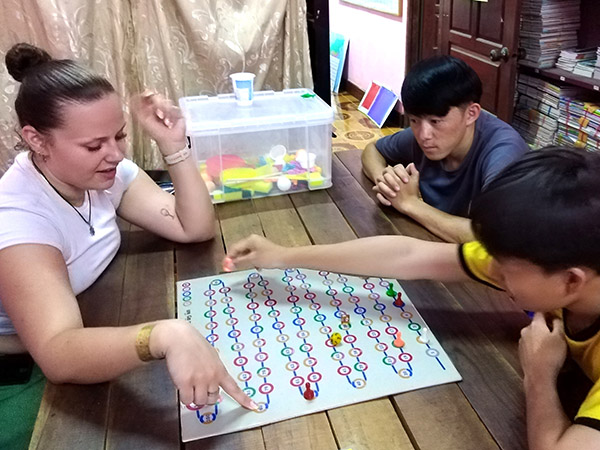
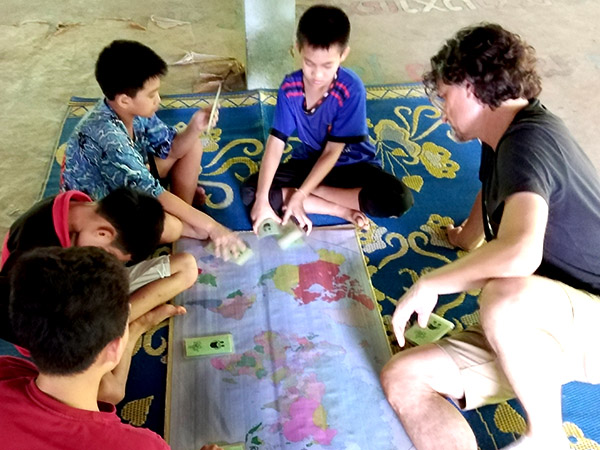
Meet young Laotians. Every day from 9:00 to 11:00 a.m., and 5:00-7:00 p.m., we invite visitors and Lao people (most are age 14 to 22) to come interact with visitors at our shop, through games and other activities. Play a fun math or geography game, or one that helps them improve their English skills.
Spend a day at our school. Enjoy games and other activities with children age 3 into mid-teens. They'll improve their English, and it's enjoyable for everyone.
Take a 5-6 day trip. Visit less-traveled parts of Laos as you see how we are transforming education for thousands of children. And help us do it.
Support us to reach more children. Most children in Laos attend schools where they learn very little; they are bored; and the rote techniques suppress their natural instincts to take initiative, to solve problems, and to enjoy learning. After you've seen more of what we do, we hope you'll consider a donation so we can build more schools and reach more children.

Students have fun on our unicycles. But that's not the full story.
When a child first sees a unicycle, they're likely to think "that looks impossible." At first, it feels impossible. But then it gets easier. Before long, they're hopping on and off as if they were born on a wheel.
They've not only learned to ride a unicycle. They've also learned that even if something at first looked impossible, it's not. They can learn it. By themselves, perhaps with a little help from their friends. That is not only an important lesson; it is the opposite of what most schools around the world teach.