
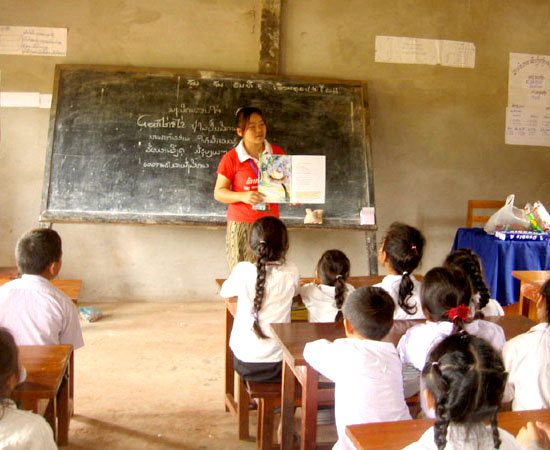

We opened our first school in 2016, with 13 students in grades 1 and 2. Today, 12 schools with 4200 students are in our network, with two more schools under construction.
 Our students usually learn to read in kindergarten or grade 1; in public schools, half the children in grade 5 cannot read a simple Lao text. But reading is only the most visible difference. Our students also learn to enjoy reading, rather than seeing it as a chore associated only with school. They learn other academic subjects, including math and geography. Most importantly, we believe, they develop broader and crucial life skills: Problem-solving, communication, cooperation, taking responsibility, and much more.
Big Brother Mouse schools fill up quickly and we must reluctantly turn away families eager to enroll their children. We're building more schools, as fast as we can raise funds. But we can never build enough, so we're also eager to improve the quality of public schools.
Sonesoulilat, who's been with us from our very first year, has worked with the Department of Education to resume the book parties through which we got books to rural schools in our early years. Now, we'll use them to improve education in broader ways. Currently we hold these starting the third week of September, until the end of April. Here's what to know:
• We're starting with ten selected schools that have committed to trying new approaches. We visit each school repeatedly.
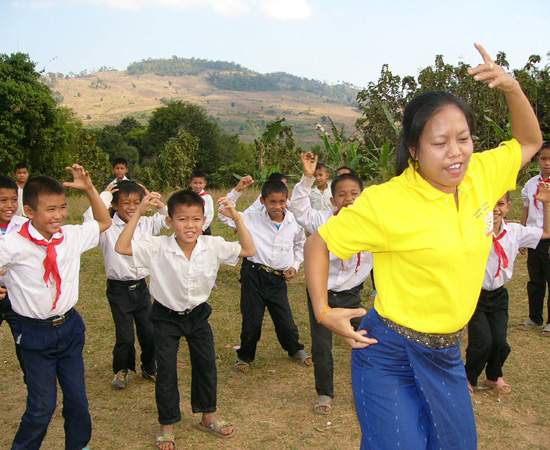
• Our team spends a half-day (usually afternoon) at each school. We make it fun, of course! We teach and sing songs about books and reading; play outdoor games; and read books aloud.
• We prioritize reading. That opens the door to learning much else. We use the books and reading-related games that have proven successful in our own schools.
• Students from our schools, ages about 9 to 15, participate along with our staff. We've broken them into smaller groups. Each group will return to the same school, so they get to know the students and teachers. Teaching others is a valuable experience for them, and with a large group from Big Brother Mouse, we can give more personalized attention to students at the schools we visit.
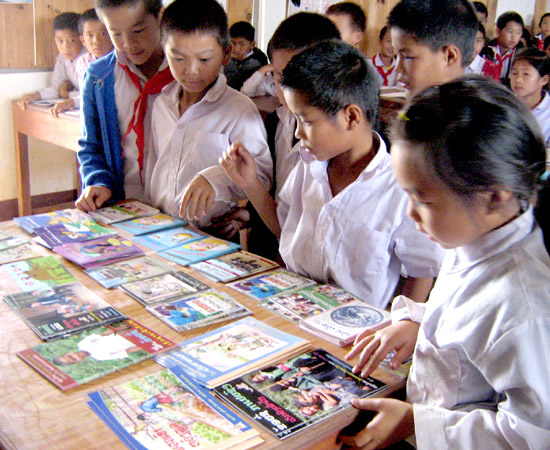
• At the end of each event, all children and teachers get to choose a free book of their own. On some visits we also give them an item such as a small set of colored pencils or an activity booklet.
• We donate learning materials to the school, as well: A set of books to make a small library. Games that are fun, and also promote learning and thinking. Posters that make it easier for teachers to try new techniques.


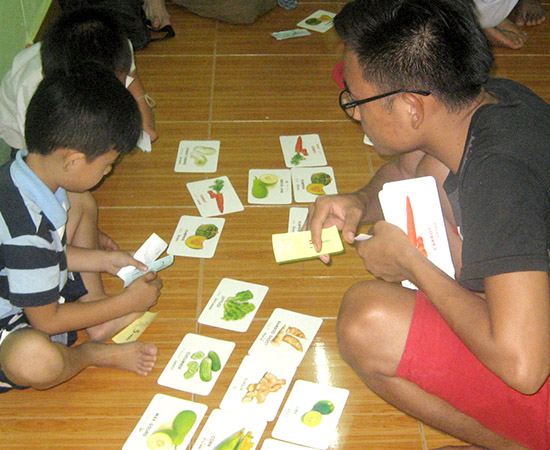
When we opened our first school, we'd already developed books and methods to teach reading. That's why, even with inexperienced teachers, our students were reading by the end of their year, a stark contrast to the public school experience.
One key to our success was that our teachers had book party experience rather than teaching experience. They knew how to get children enthused about reading. They wanted to do so. They brought that spirit to our new schools. Now, we'll bring it to more schools.
Another key is that we've tried many new approaches, and pursue those that work. By trial and error, we developed what we light-heartedly call "The Worst Children's Book in the World." It fails in every respect except one. But that's the one that matters. It gets children reading.
Our current book parties have another a big advantage compared with our early years. Today, Big Brother Mouse schools are well-known for providing quality education. We've demonstrated that we know what works. We expect that our reputation, innovative methods, and repeat visits, can have a notable impact.
We receive no government funding for this program. Government school budgets are low – new teachers often must work as volunteers, for many years, hoping that a paid position will open up.
This new effort will be possible only through donations. Please consider contributing $300 to $400 to sponsor a book party, or give any amount you can for us to use where we feel it will have the most impact. Our WordsToShowReader tells how, and provides details about tax deductions.
Are you coming to Luang Prabang? We're eager for those who have made our work possible, to see what we do. Please read about attending a book party if you'd like to do so.

With all the activities and games our schools offer, observers sometimes ask, "Do students also learn reading, math, and so on?"
Absolutely. Learning to read is mostly about motivation. Knowing that books have fun stories in them, seeing your peers and parents reading, and being surrounded by books, all help. For a motivated child it takes some time to learn to read, but not a lot. If it's not happening, more hours of reciting the alphabet is not going to fix things.
Walk into one of our first-grade classrooms mid-year and you may find students absorbed in our book The Crow Looks For the Horse. By most definitions, it is the worst children's book ever published. It has no pictures, no characters, no storyline, no color. It's got only one thing going for it: It works.
This book contains lists of rhyming words. There's a "headword" in bold type, and under that are words that rhyme – only the first letter is different. (The book's odd title, in Lao, is 'Gaa Maa Haa Maa.')
For as long as they've been in our school, kids have heard stories read aloud. They know there's something good in those books. They'd like to get at it themselves... just like a grown-up!
In kindergarten they learn the alphabet. Then, after they've read the headword (which may require some help at first), they just need to change the opening sound, and they can read each new word below it. They can say to themselves, 'I'm reading!'

Lao is phonetic, so short words that rhyme are always spelled the same except for the opening consonant. We've got none of the confusion caused by English words such as toe though tough through to two ....
By the end of first grade, some of our students are reading Lao folktales, with a paragraph (and picture) on each page. Others read our 200-page Lao adaptation of The Wind in the Willows.


