

Director: Vanhphet Vongpaseut
Location: Phanom Village, Luang Prabang District and Province
Opened: September 2026
Classrooms: 8
Enrollment: 90 students
Grades: Preschool and primary school
Sonesoulilat (usually known as Sone, which rhymes with 'dawn') has been a key part of Big Brother Mouse almost from the beginning. In 2006, which we were four months old and Sone was 16, he took a part-time job helping us after school. We quickly began to discover his wide-ranging talents.
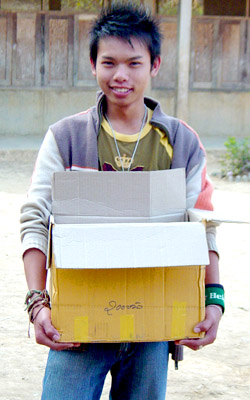
We had held a couple book events at the local library. Sone took this to a new level, putting together book parties at local public schools, then in schools outside Luang Prabang, and then more widely. By 2012 he was coordinating five teams on the road, reaching 900 schools and100,000 children each year. He's shown here at one of the earliest of these events, in about January 2007.
He also wrote several books, ranging from What's In The Market, which remains popular with visitors who want o learn about unfamiliar items in the local shops, to a beginner-level Lao book, Black Mouse White Mouse.
Always entrepreneurial, Sone also started a business designing and making fashionable but affordable clothing, then other businesses. Pan Boun restaurant (it means A Thousand Blessings) overlooks the night market in town and is a perfect spot to enjoy a Lao meal if you visit. It's across the street from the tiered roof of Wat Mai.
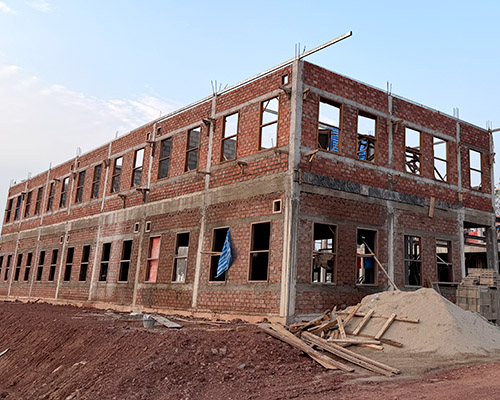
Now, Sone has also opened Dolphin School, on the outskirts of Luang Prabang. For this, he took out a different approach from our other schools. Rather than looking for donations, he borrowed funds for construction and to lease land. To pay back the loan he will charge a higher tuition than other schools in our network, but much less than most private schools in the city, and well affordable for much of the population nearby.
Some may believe we should focus only on schools for the poorest children. We strongly disagree; here are a few reasons.
* Whatever their family background, children should be entitled to a good education. Right now, middle-class children may attend a private school that's slightly better than the public schools, but far short of what they need. The better private schools cost hundreds of dollars a month; only foreigners and wealthy Lao can afford that. The two other Big Sister Mouse schools in Luang Prabang are full, and are located too far from many neighborhoods.
* This school couldn't be built except with a loan, and repaying that requires a higher tuition. We hope this can become a model for new schools in other towns. Where land is less expensive than in Luang Prabang, the tuition difference will be less. We can reach far more children if we don't have to raise funds to build a new school each time.
* Some of the children who attend Dolphin School are likely to end up in government and other policy-related jobs, where they will infuence decisions about everything from foreign affairs to school regulations. We want them to have seen, and benefited from, the difference that a strong education can make.
Pom was planning Little Deer school at the same time as Sone was also making plans. Pom mentioned that he chose the name Little Deer because "I wanted an animal that doesn't eat other animals." Sone had been tentatively calling his school Little Tiger. He gave the matter some thought, and decided to instead call it Dolphin School. (As of its second year, it will extend through high school level, so he decided to drop the word 'Little'.) We will not ask what dolphins eat. And who cares? Dolphins have a nice smile.

Students have fun on our unicycles. But that's not the full story.
When a child first sees a unicycle, they're likely to think "that looks impossible." At first, it feels impossible. But then it gets easier. Before long, they're hopping on and off as if they were born on a wheel.
They've not only learned to ride a unicycle. They've also learned that even if something at first looked impossible, it's not. They can learn it. By themselves, perhaps with a little help from their friends. That is not only an important lesson; it is the opposite of what most schools around the world teach.