In the long run, our vision is that quality education and books will be an important part of Lao culture, and a company like Big Brother Mouse can be self-sustaining. Right now, when the average annual income in Laos is about $2000 U.S. per year, we welcome your support as we work toward that goal.
In most cases, the simplest and best way to donate is through the Laos Literacy Project, a non-profit, tax-exempt 501(c)(3) organization in the United States which sends 100% of your donation directly to Big Brother Mouse. Click the Donate button to contribute, using PayPal or a major credit card, through the secure PayPal site. If you would prefer to donate directly, with a bank transfer, please read further.
From outside the United States: We can receive donations through WISE, which we find offers good exchange rates when converting other currencies into dollars. For details contact Kathy Kronenberg at kkronenberg@att.net
From Australia, New Zealand, the United Kingdom, and Switzerland: You can contribute through an affiliate with a tax-deductible status in these countries; for details click the country: Australia, New Zealand & United Kingdom, Switzerland.
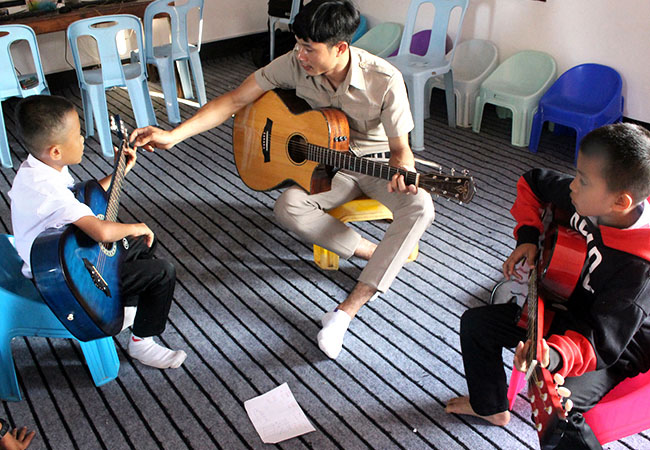
At our Big Sister Mouse schools, we're developing education methods of a different sort: Not memorizing facts from a teacher or textbook, but hands-on activities; thinking about ideas through reading, discussion, and writing; and taking on projects, such as devising and testing out ways to build interest in reading. But these are new ideas here. We take young adults who have a teaching certificate, but no experience with these approaches, and give them time to see and acquire skills that will help children develop their full range of abilities. Your donation supports four months of such programs, which may be split between several new teachers. Most of these teachers come from rural villages. We provide room and board, as well as training.
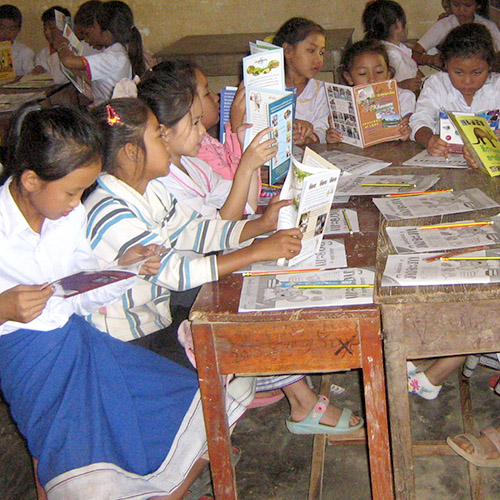
It costs about $1,500-$6,000 U.S. to publish and print a new book, but we can pay some of that, and other overhead, from sales. A sponsorship of just $800-$3,500 U.S. is all that's needed to bring a new book into Laos. Books that need sponsors.
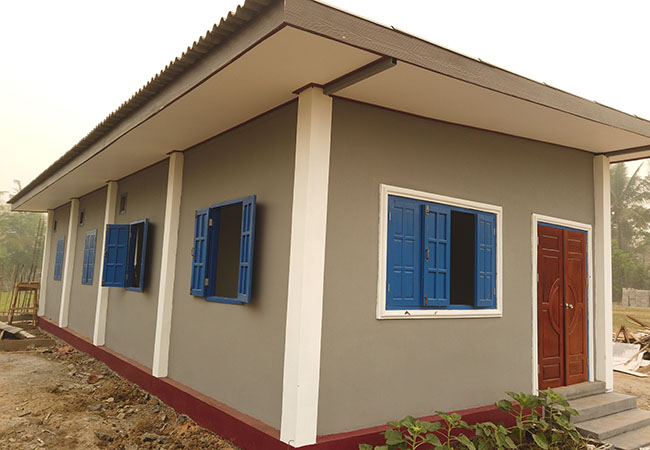
We now have 4200 students at 12 schools in northern Laos and we are building more. Here's what needs your support right now.
By major credit card or PayPal: You may use the button at the top of the page to donate to the Laos Literacy Project, a non-profit, tax-exempt (501-c-3) organization in the USA. For American taxpayers, these contributions are tax-deductible to the extent allowed by law.
The Laos Literacy Project was created to provide support for Big Brother Mouse and our work in Laos. It is volunteer-staffed. The small overhead costs of the organization are paid by the founders; all of your donation, except for the standard fee taken by credit card companies, will go to Big Brother Mouse in Laos.
By check (US dollars): Donations can also be made by check to the Laos Literacy Project. For American taxpayers, they are tax-deductible to the extent allowed by law.
To donate: Checks may be sent to:
Kathy Kronenberg
Laos Literacy Project
2 Madre Mountain
Santa Fe, NM 87508
United States
Please enclose your name, address, and email address if available, and make checks payable to Laos Literacy Project. (Note that this became our new address in early 2023.) Thank you!
Bank transfers and Wise. If you wish to donate from abroad to the Laos Literacy Project in the U.S., or to Big Brother Mouse in Laos (which has a dollar account in a Lao bank), you can do so with a transfer from your bank. Because of the bank fees involved (which vary by bank and by country), this is usually best only if you are donating more than $1,000. Or consider Wise (wise.com), a commercial money transfer service which generally has good exchange rates and a simple registration process. For details about where to send, please ask Kathy Kronenberg at kkronenberg@att.net when you are ready to donate to Laos Literacy Project, or contact us at Big Brother Mouse for details on making a direct transfer to us in Laos.
Retirees in the USA. The U.S. tax code has a special provision for people over age 70-1/2 with an IRA account: If you donate (up to $108,000 in 2025) from your IRA directly to a tax-exempt charity such as Laos Literacy Project, it is a "qualified charitable distribution" which bypasses the tax process entirely. In many cases this is better than withdrawing the money and making a contribution, because that may hit limits on how much you can deduct.
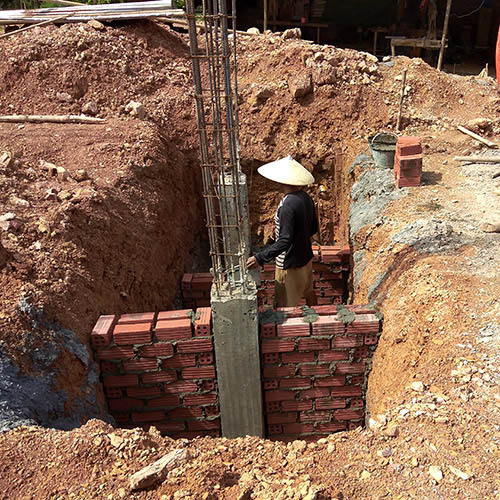
The only thing that prevents us from reaching more children is finding the funds to build a new school. After a school is built, it becomes self-sustaining. Can you think of a better ongoing legacy?
We like to know who's helping us! If you donate to Laos Literacy Project via PayPal, check, or bank transfer, we'll know. We will record your donation, in your name.
If you donate through the Global Development Fund (Australia, NZ, UK) or basmati (Switzerland), and would like us to record the donation in your name, please send us an email after you make the donation, giving the amount, date, your name, and how the donation was made (for example, "by credit card to Global Development Group"). This is particularly necessary if you are sponsoring a classroom or school or book. We want to acknowledge you. But do also let us know if you prefer not to have your name appear, or would like to be listed in a particular way (as a business, for example, or with a partner's name). Thank you!

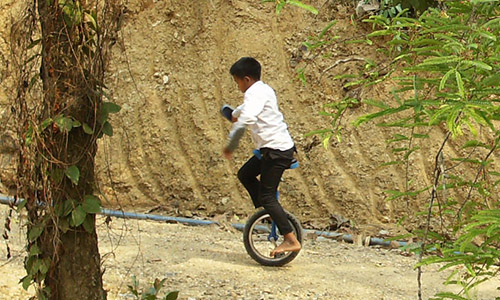
Visitors sometimes ask: Why do you have unicycles?
Because kids have fun on them. That's reason enough. Children are required to attend school, but that doesn't mean it needs to feel like a prison!

There are other good reasons, as well. When a child first sees a unicycle, they're likely to think "that looks impossible to ride."

When they first try, it feels impossible. But after a few tries, it starts getting a bit easier. Soon, they are hopping on and off, riding around as easily as if they were walking. Soon they're trying new things, going over a bump or down a ramp. One group of boys all tried riding backwards one day. They were able to do it but soon stopped, for precisely the reason that you probably already thought of.

We have unicycles because now students see something that looks impossible, but soon they learn to do it. And they learn it by themselves, perhaps with a little help from their friends. That's every bit as important as any other lesson they will learn.