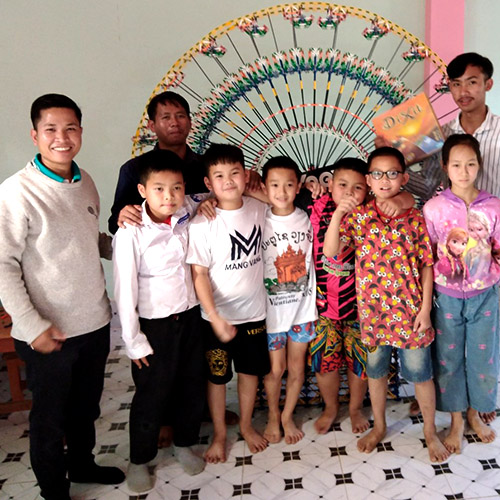
When Pom Punyarkeo first came to Big Sister Mouse school as a teacher, he had a similar background to other new teachers. The only school model he knew was of a teacher at a blackboard, telling students what to memorize for the test.
He quickly saw that our active approach to learning was a big improvement; and we quickly saw that Pom was an exceptionally capable addition to our staff. We gave him one new responsibility after another: Managing our growing assortment of games and activities; helping to develop a sign language curriculum; helping at the new Little Rabbit school after the sudden and tragic death of its founder three months after it opened; setting up a teacher training program; and being a lead guide on our first visitor trips, to Nong Khiaw and Little Rabbit.
Then, not surprisingly, he was eager to start another school, which he has named Little Deer. He chose Xayabouli, the capital of the district of the same name, as the site. Visitors who had met Pom on our trips shared our confidence that he could do a superb job. We quickly raised enough money to build a school. He started construction in November 2025, and he expects to finish by mid-2026.
This trip takes us to three of our newer schools. At each school you'll have an opportunity to engage in the activities of your choice, with students who range in age from preschool to grade 5 (about age 10). Outsiders are rare at all three of these schools, so our visits will be an exciting event for both children and teachers.
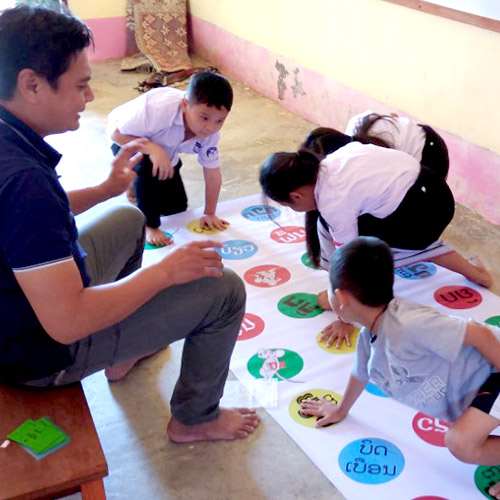
What will you do at each school? We've got over a hundred games and activities, you can choose based on your interests and energy level. Many are designed to help children learn English. With our "Hop Home" game, you read an English command to a student, such as "Walk like a spider" or "Make a sound like a pig." They have fun following the commands, as they learn to understand English. Other games make it fun to improve number skills, use a compass, or learn about other countries.
There is always an eager demand for visitors to read simple English books aloud with children, helping them learn the sounds and words. Very young children can quickly learn sounds that don't occur in their language, by copying a visitor. This gives them a big head start on learning a language.
Each trip is joined by several students who speak some English, typically about ages 9 to 12. The trip price subsidizes this, and travelers report that the children add greatly to their experience. For the children, it's an exciting new experience and opportunity to use their English, see new places, and make new friends. When schedules permit, a few teachers also join, in addition to two of our Lao staff who run the trip.
In addition to any scheduled departures listed below, we can usually arrange a custom departure on request, preferably with at least a month's notice, for a group of four or more. (For fewer, add a $300 surcharge.
Here's the schedule:
Road conditions through this area have been bad, with many large potholes that slow traffic. Some repair work has begun, but it's impossible to predict conditions in advance, so times represent a likely range.
Sunday: We'll cross the Mekong River into Chompet district, to walk along a rural trail that takes us through the forest to a hilltop overview and several beautiful Buddhist wats. We typically come back early afternoon. However, there's a network of rural roads and trails here. If you want to explore more, it's easy to come back independently, earlier or later, by yourself. We'll have an evening welcome dinner.
We do not include accommodations on this night; most people will have already been in town for a day or more and prefer to stay where they are. If you're on a tight schedule, you can miss the Sunday walk, you can even miss dinner as well; just don't be late for the Monday morning departure.
Monday: Drive to Xiegn Ngen (40-60 minutes) at the foot of the mountains. Spend a full day at Big Sister Mouse 3, which opened in 2025. Engage in reading, games, and activities with students; if you tire out before they do (spoiler alert: you probably will) you can just watch. Then we'll drive on to Xayabuli district (2 to 2-1/2 hours), and settle into a comfortable guesthouse for two nights.
Tuesday: Spend the day at Little Deer school, engaging in games and activities with students, helping them practice English, or simply observing.
 Wednesday: Those interested can go to the Elephant Conservation Center outside of town. Here, elephants once used for logging live in natural conditions, free from the demands of industry and also of tourism. There's no elephant riding here; just an opportunity to watch these impressive animals from a short distance away. Those who prefer can spend another day at Little Deer School. Late afternoon, we'll drive to Nan District (40-60 minutes), home of Little Bear School.
Thursday-Friday: We'll spend two days at Little Bear School, and on one day we'll make a day trip (50-80 minutes) to Little Deer School in Xayabuli. Little Bear was founded and opened by Kongsy, the director of our first school, in 2023. He has created a welcome oasis of good education in his new hometown.
Spending two days at a school creates a very different experience from a single day. Visitors get to know some of the teachers and students, and can sometimes build on the day's activities rather than starting over.
Mid-afternoon on Friday, we'll drive back to Luang Prabang, and enjoy a farewell dinner in town.
November 8-13, 2026. $800 per person. Single-room supplement: $80. (All prices are in U.S. dollars.)
Group size is limited to 10 visitors.
Deposit: $200 per person.
This includes all meals but one, starting with lunch on the first day, ending with our farewell dinner, and 4 nights of clean, comfortable, but not deluxe, accommodations on the road. (Breakfast on the first day, in Luang Prabang, is not included; there are many options to choose from.) The price also subsidizes some of our students who are learning English to join us. They are typically ages 9 to 12. They greatly benefit from the experience while also adding energy and excitement that increases the enjoyment for everyone.
Food: Meals feature dishes that visitors from abroad will enjoy, with local ingredients. We are happy to accommodate vegetarians and some dishes are usually meat-free in any case.

Ever since motorbikes became widely accessible, walking has fallen out of favor. Not just in Laos; that's the trend worldwide, whether because of motorbikes or cars.
But just as children are eager to learn, and have an instinct to acquire language, they also naturally love walking. It's good for them. It builds up a healthy lifetime habit. It helps them develop a love of nature.
Soon after we opened our first school, we tried something ambitious: Walking along the unpaved road in front of our school, 2 kilometers of level road then another 4 kilometers uphill, where the van met us and brought everyone back. Some children were so exhausted they fell asleep on the ride back. But a week later, they were eager to do it again.
Everyone at the time talked as if that had tested the limits of human potential. But within a few months we had a new route: Up the same hill, along a ridge and past a strawberry farm, a lunch stop, then down a trail through a fern-filled forest, stopping at a small waterfall with a swimming hole, briefly along a not-too-busy highway, then to the Hmong village of Kua Ti Neung and back to the school. A 12-kilometer circuit.

We've found more routes: An 8-kilometer trail from a dead-end road in the mountains leads down to Kwangsi waterfall, which you probably visited (via an easier route) if you ever came to Luang Prabang. An 8-km round trip, on the other side of the Mekong, that takes us to a remote, beautifully-landscaped Buddhist temple.