


Founder and Director: Kongsy Vilayphone
Location: Nan District, Luang Prabang Province
Opened: September 2023
Classrooms: 8
Enrollment: 273 children,
Grades: Preschool and primary school through grade 5, ages 2-10
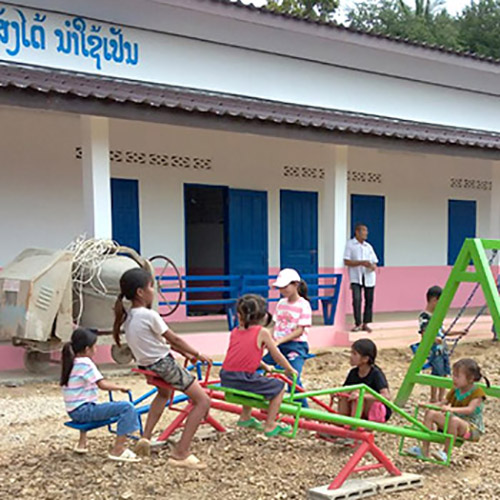
 Kongsy Vilayphone (shown here – he's the smaller of the two) was part of the Big Brother Mouse team, publishing books and getting them into the countryside, before we ever thought about opening schools. He enrolled his son at our first school, Big Sister Mouse, and quickly saw the value of active learning. When Siphone, the original director, left to open another school, Kongsy became the new director.
After helping Big Sister Mouse grow, he wanted to open a new school away from the city, so more children could get the quality of education that we offer. He and his family moved to Nan district, on the road from Luang Prabang to Xayabuli province, where he built and opened Little Bear School.
Soon, he and his family got a reminder of how important their new school would be. His son was too old to attend Little Bear so he enrolled in the public school. The first day's homework assignment was a shock. "Write the letters of the alphabet." The teacher wanted to know which of the children, ages 11 and 12, had learned the 27 letters of the Lao alphabet, and which had not.
Full up
Finding funds to build a school is the biggest challenge we face when we consider going into new areas. Next biggest: Finding teachers. There is a teacher shortage nationwide, because many young people have moved to neighboring countries in search of better-paying jobs. Further, we're looking for teachers who can learn our methods of getting students engaged, rather than believing that their job is to stand at the blackboard and tell children what to remember for the test. Most can learn this, and come to appreciate it, but it takes time.
So the first year, Kongsy opened just through grade 3 (about age 8). Finding those teachers was challenge enough. In September 2024, he expanded to go through grade 5, and quickly filled up. More families arrived asking to enroll their children and had to be turned away.
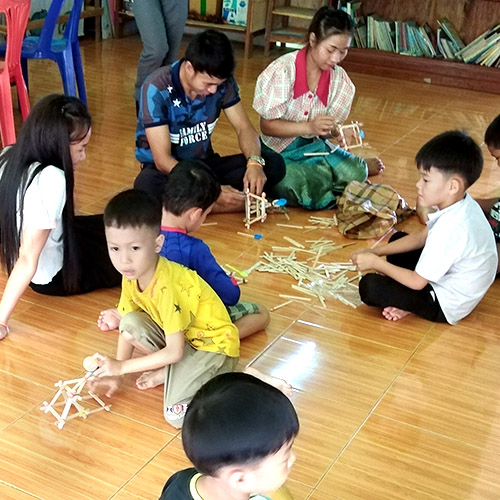
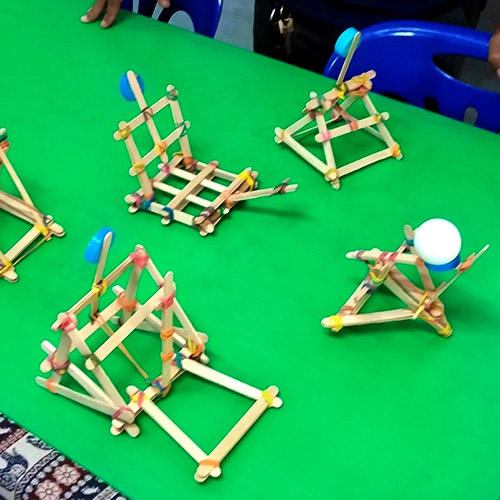

Popsicle-stick catapults
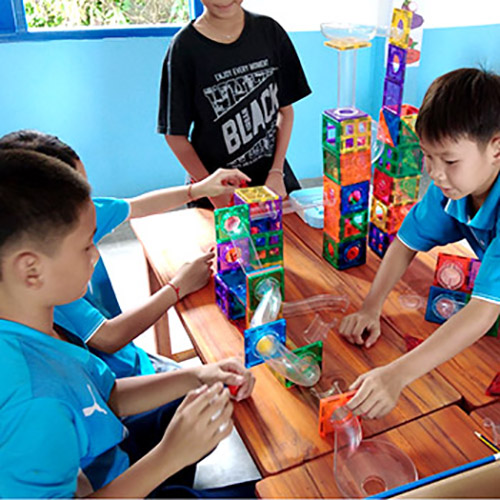
Again and again, in both theory and practice, it's been shown that the rote teaching methods prevalent in so much of the world are the wrong approach. They sometimes help students get good scores on standardized tests, though often they don't achieve even that. They do not help children develop in the many dimensions that we all think are important. They do not improve understanding of history, science, or environmental issues. They do not help children develop curiosity, imagination, problem-solving skills, initiative, perseverance, or the ability to work with others. As they fail at all that, rote-based schools also create a lot of misery and unhappiness.
So why does this system persist? Too many factors are at work to discuss them all here. One is simple: A belief that letting children 'just play' is a waste of time that could be spent on preparing for the next test.
But it's not a waste. Let's look at an activity that might seem frivolous: Use popsicle sticks and rubber bands to construct a catapult, which can fire a pingpong ball. Who can fire their pingpong ball the farthest?
We suggest other items to construct, but we start with catapults for a good reason. It's hard to keep the attention of an eight-year-old boy, but the opportunity to build a weapon of mass destruction is a sure-fire winner. We show them a working model to communicate the general idea. Then we take away the model.
Now, students cannot just copy. They must come up a design themselves, and try it. Their first model probably won't work. They have to fix that problem. When they've got a design that works, they have to think of ways to make it shoot farther. After a few rounds, they'll come up with other improvements. In other words, they are setting goals, hitting roadblocks, thinking of possible solutions and trying them out. Those habits will carry them much farther in life than memorizing answers someone else has told them.
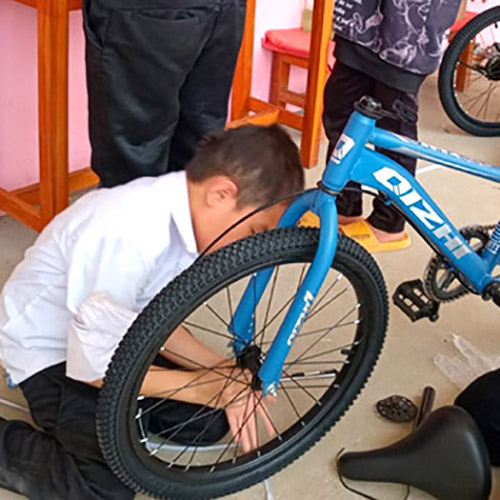


Typically, about half the boys and almost none of the girls can ride a bike when they enroll at one of our schools. That quickly changes. We've bought a fleet of child-sized bikes for each school. Students help assemble them, then learn to ride. A year later, some are riding a bike to school instead of being driven by parents. Our very modest tuition fees don't cover extras like bikes. These extras are possible only because of supporters who want help children develop in many capacities. Will you help too? Donations are tax-deductible, as allowed by law, in the U.S, Australia, New Zealand, and Switzerland, and qualify for Gift Aid in the U.K. Our Donations page spells out the options. Thank you!

When we opened our first school, in 2016, we already had two people on our staff who were deaf and we taught children some basic sign language. "It's fun!" was the nearly universal response.
The book Dancing With Words, tells about the use of sign language in certain U.S. schools. There, too, children consistently described it as fun, and researchers saw educational benefits.
We're now developing the curriculum with the goal that children can carry on a full conversation by signing. They learn a few words, get practice using them in sentences, then learn a few more, and practice with more sentences.
Visitors sometimes ask why we teach sign language. Lots of reasons – more than may be obvious at first.
• If they meet someone who uses sign language, they'll be able to communicate. That's a good thing for everybody.
• In the countryside, many people who are deaf have never had an opportunity to learn sign language. Often they're dismissed as not-too-bright. (Remember that "deaf and dumb" was once a common English term. And it still gets used.) A wider awareness of deafness and sign language is one step toward addressing this. Some of our students may one day create initiatives to help make sign language more widely taught to children who will benefit most from it.
• Children like using their fingers and hands. At times it seems that they are instinctively driven to do so.
• Learning any other language brings many benefits. This is even more true of sign language than a spoken language, because the physical component activates other areas of the brain.
• Studies in the U.S. (reported in Dancing With Words) have shown that learning sign language helps small children learn to read. Several dynamics seem to be at work. One is that it helps them grasp that speech consists of individual words.
• We're not sure, but it seems that because people look at you more closely when you're speaking with sign language, it can help children gain more self-confidence about speaking or performing in front of others.