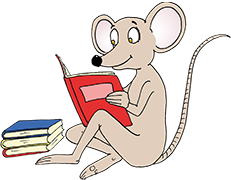

Our story begins in 1983, when a boy named Khamla was born in a small village about 50 kilometers from Luang Prabang.
He started school when he was eight, and was the first in his family to learn to read. When he was 12, Khamla's family decided he was so bright and studied so hard that he should move to Luang Prabang. There, as a novice monk, he could get a better education at the temple school.
He made the journey by boat; there was no road at the time. It was a six-hour trip, and he didn't see his family again for nine months.
"At first I was very unhappy and homesick, and sometimes I cried," he recalls, but soon he grew to enjoy novice life, and he has happy memories of that period. He also coined a family name for himself: Panyasouk. Most Lao people at that time had only a single, given name.
This picture was taken by a tourist. Occasionally he saw tourists in Luang Prabang. Many of them read books when they had spare time. "Why would they do that when they're on vacation?" wondered Khamla, whose only experience with reading had been a few dull, tattered textbooks.
But he had no access to other books in his language, and wouldn't learn the answer to his question for many more years.

As Khamla took his long boat trip to Luang Prabang, Sasha Alyson was selling the publishing company in the United States that he had run for 15 years. He then had a travel business, and in 2003 that took him to Laos.
As a former publisher, he looked to see what Lao people were reading. The answer was: Nothing. "On that first trip, I never saw a book in the Lao language," he says. "I wondered: Could I help young people learn publishing skills, while producing books that would improve literacy and education?" As he proposed the idea to various people, he kept hearing the same four-word response: "Lao people don't read."
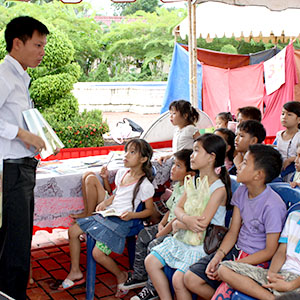
While exploring that possibility, Sasha stopped at a local cafe one day. It was slow season. The waiter, Siphone, was working his way through Teacher Training College. English instruction there was weak, and he was eager to practice it with the shop's only customer. He not only wanted to improve his own skills, he also had a strong drive to help others learn. They came up with a plan.
Siphone rented a double-sized student room. Sasha bought three inexpensive used computers in Thailand and brought them up and Siphone made them available at very low cost (equivalent to 10 U.S. cents for 30 minutes) to other students who wanted access.
His first employee was Khamla. They had been novice monks together, and were close friends.
They soon learned that while college students liked the English programs, they were in fact more eager to use computer time to learn office skills, such as word processing. They had other ways to practice English, such as recordings on CD, but no other way to learn office skills that employers wanted. Sasha often dropped by to help, and to talk with Siphone and Khamla about publishing ideas.
Siphone's not a waiter anymore. Come see what he's done instead!

Meanwhile, Sasha was talking with government officials, teachers, and students about his goal of publishing "Books that make literacy fun." Many people had only seen textbooks. They didn't understand how a book could be fun. So, while working together at the shop, we (Siphone, Khamla and Sasha) wrote our first five books. We printed single copies from a computer so we could show people how books could make literacy fun.
Siphone wrote down the traditional stories his grandmother had told him in the evenings. The Cat That Meditated remains one of our most widely read books, and he's written several other highly popular story collections since then.
Khamla wrote an alphabet book that uses humorous rhymes and cartoons to introduce each letter of the Lao alphabet. Frog, Alligator, Buffalo is so widely used, that many children can recite parts of it by heart.
Sasha wrote Bangkok Bob, about a monkey that is both delighted and overwhelmed by a first trip to the big city – just as a Lao child would be.
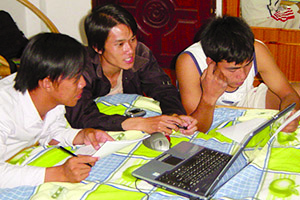
We couldn't publish those books yet. Publishing in Laos requires a special license, and each book must receive government approval before it is printed. We didn't have all of that in place, but as we worked on it, we also kept working on new books. Ounla (left), an art student in Vientiane, illustrated many of them. Thongkham (center) translated several. Here they work with Khamla in our first "office," a guesthouse room in Vientiane, on our first non-fiction book: Animals of Africa. Among other issues that came up: The Lao language did have a word for giraffe; if you look that strange, people everywhere are going to talk about you! But it had no words for aardvark, primate, gazelle, or other animals. What should we call them?

June, 2006 was a big month. Khamla graduated from Teacher Training College. He got a business license. (Big Brother Mouse is set up as a Lao-owned, not-for-profit business.) Then he applied for a publishing license. The last step took extra time. Luang Prabang officials had never before issued a publishing license. We still have the only such license in Laos outside of the capital. That same month we opened our shop, complete with a freshly-painted mouse. We had published 6 titles, and we put them on display. Khamla hung up a sign: "Bookshop." We did, after all, have more Lao-language books for sale than any other shop in northern Laos.
(We have added this to our website in January 2025. We plan to continue the story in the weeks ahead.)
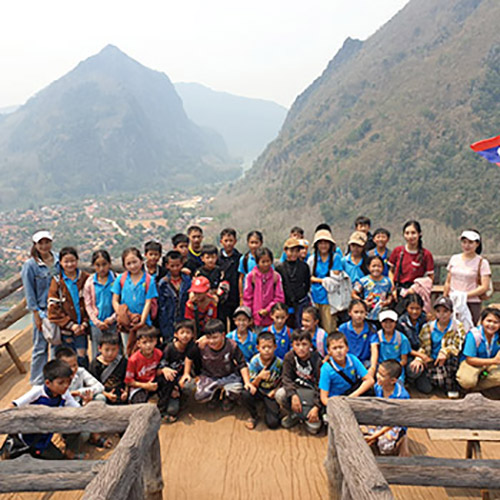
Seasoned travelers know that new experiences provide an education you can't get in a classroom. On a trip to nearby Nong Khiao, Ton Kit students climbed a mountain to a scenic viewpoint.
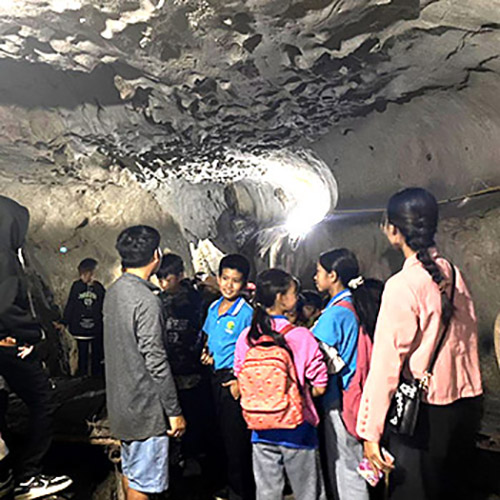
Then came a more somber site: The cave where their grandparents' generation took refuge during the decade of air bombings by the U.S. from 1964-1973. That is often called the Vietnam War, but the secret U.S. bombing campaign made Laos the most heavily-bombed country, on a per-capita basis, in world history. More bombs were dropped on Laos than were dropped in the entirety of World War II. The New York Times estimated in 1975 that 10% of the Lao population, nearly all of them civilians, were killed. This secret war is now well documented, yet remains largely unknown.
An estimated 30% of the bombs did not explode on impact. Unexploded bombs (UXOs), buried in the ground, continue to kill farmers plowing a field and children fascinated by the shiny object they've uncovered. Mr. Noh, who worked at Big Brother Mouse while a student in Luang Prabang, has built a small museum to display these; the pillars in the photo were shells which contained thousands of small bomblets.

Big Brother Mouse offers trips for people who would like to interact with children and teachers at our schools, to see other notable sights in Laos, and meet a few of our staff and students, who join us for five days on the road. Our Nong Khiaw trip includes visits to two Ton Kit schools, as well as opportunities to hike up to the overview, and to visit the cave and the UXO museum. Details at Nong Khiaw Trip