


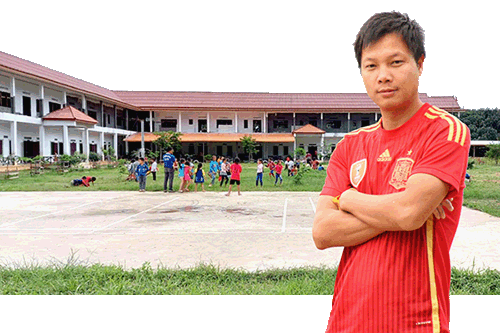
Siphone Wuttisakdy has been a key member of our team right from the start. He wrote two of our first five books and 26 more after that. Then he was director of our first school. After a visit to his home village, appalled that his nephew entering grade four couldn't read his own name, Siphone moved back and opened the first Ton Kit School in 2019, then two more schools, with over 1200 students in all.
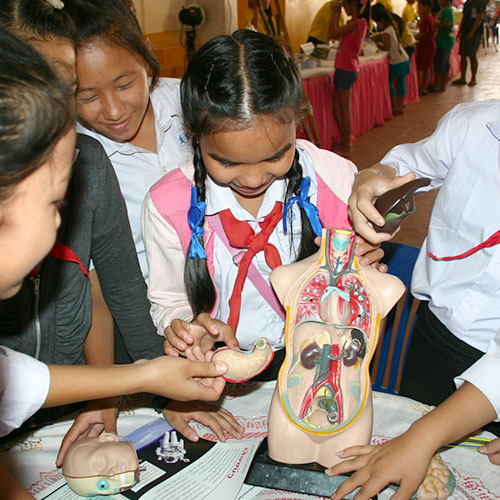
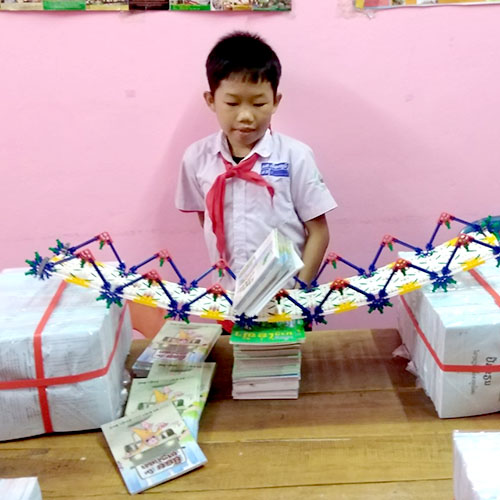
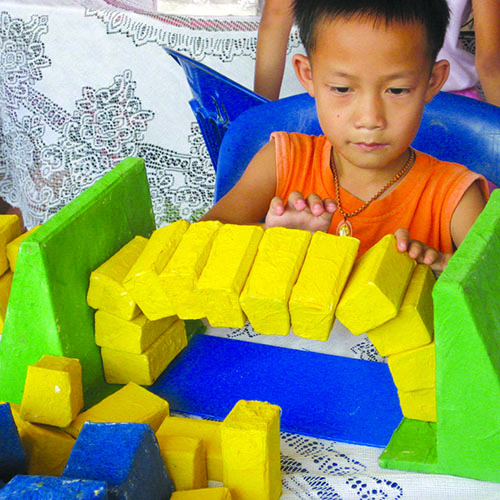
Now he's planning something different: A new learning center, called Discovery World, where children from our schools and others can benefit from a variety of new experiences. If you've been to a children's museum, you'll have a broad sense of what he has in mind although he'll have to start on a smaller scale. (Photos at the top and bottom of this page show similar activities we've done on a temporary basis, at other locations.) He will also display traditional crafts and livelihoods of Laos, which some children no longer see. Plus swimming, and hiking in the hills across the river.
He'll provide sleeping accommodations so that a school class can come for a multi-day visit, and also rooms for visitors from abroad who would like to experience this along with the children.
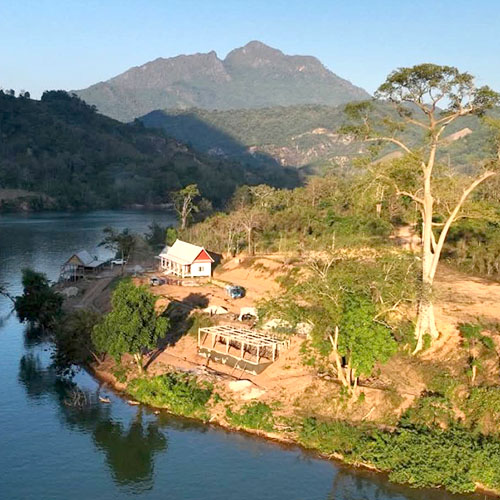
The location: Nong Khiaw, a scenic resort town 145 kilometers from Luang Prabang, on a riverside plot 2 kilometers from the town by boat, a bit longer on a rural road.


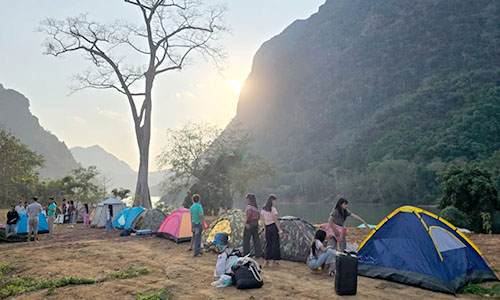
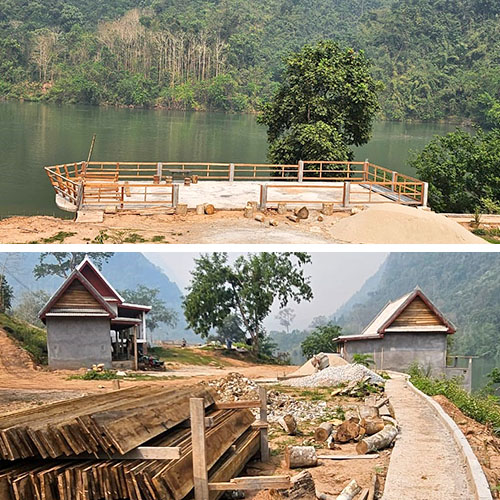
Above: Construction began in February 2026. Siphone has already hosted overnight trips, with students camping on the land as they enjoy outdoor activities.
New teachers at our schools have no experience with the active-learning philosophy that is the heart of our schools:
• Children learn by play and discovery.
• We want children to learn because it excites them, not because they're afraid we'll punish them otherwise.
• Reading all sorts of books is a great way to expand the mind.
• Outdoor activity is good for the body, the mind, and the soul.
• Memorization is useful it its place, but it is not thinking. It should not be the goal of school.
• Phones interfere with children's ability to focus on people and things around them.
Those are all new concepts here. Discovery World will provide an opportunity for teachers at our schools, and others, to see those principles in action.
Before beginning any construction, Siphone had another job to tackle. From 1964 to 1973, during what Americans call the Vietnam War and SE Asians call the American War, the United States secretly launched massive non-stop bombing raids on Laos, leaving Laos as the most heavily bombed country, on a per capita basis, on earth. (If this sounds like hyperbole, do a web search for "Is Laos the most bombed country?") Much of this consisted of cluster bombs, each of which indiscriminately dispersed hundreds of tiny bomblets over a wide area. An estimated 30% of the bomblets failed to explode on impact. Many today still lie hidden in the soil, waiting to kill or maim a farmer plowing a field, or a child fascinated by a shiny object in the ground.
Nong Khiaw was a major target. Families moved from their village homes into caves in the cliffs where they established entire communities with shops, schools, and hospitals. We visit one of these caves on Big Brother Mouse's Nong Khiaw trip.
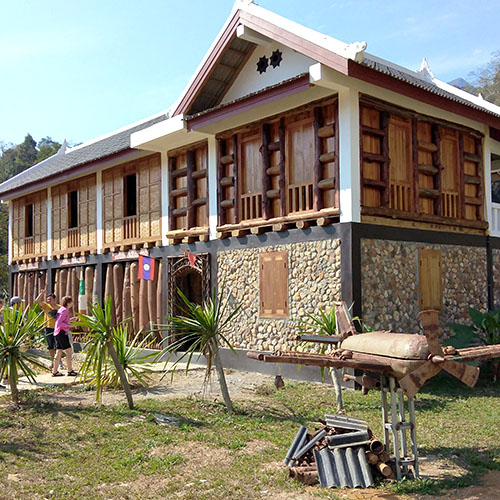

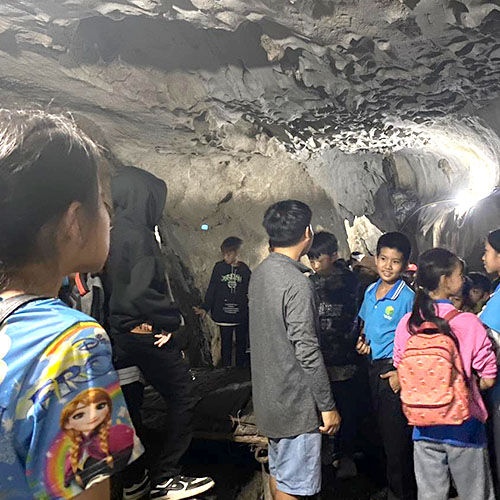
Anyone who has joined one of our Nong Khiaw trips, where we visit Siphone's schools and spend a few nights in Nong Khiaw, has surely been impressed by Siphone's achievements. He's created three schools where children discover that learning is fun.
Becky Schaller joined us on that trip in 2025. Like everyone who has visited schools that Siphone created, she was impressed by his achievements. Equally, she was horrified to learn of what her country, the U.S., secretly did here a half-century ago, and of the deaths and maiming that still result from those bombs.
We can imagine a world in which the country that secretly and illegally dropped these bombs would be required to clean up after itself. We don't live in that world. It's up to individuals who care about this to think about where we can make a difference. Becky wants to support Discovery World, and has offered to match donations up to $25,000, for the first stage, and another donor has offered the same amount. Thus if we get $50,000 in donations, we'll have a total of $100,000 for Discovery World.

Will you help us make Discovery World a reality? Donations to Big Brother Mouse of U.S. $2,000 or more can be designated for Discovery World and will be matched. If we hit the matching limit of $50,000, you'll have a choice of donating for Discovery World without a match, letting us use your donation for a different project... or maybe someone else will offer a further match. Siphone has 1.4 hectares, which is a lot of land. He could productively use much more in his first eighteen months.
Siphone is ready to go. He's already had the land cleared. One UXO (an unexploded ordinance) was in fact found and removed. Let's help him build a Discovery World for Lao children, on the spot where the American bombs fell on their grandparents.
Donations are tax-deductible, as allowed by law, in the U.S, Australia, New Zealand, and Switzerland, and qualify for Gift Aid in the U.K. Our Donations page spells out the options. Thank you!



In 2004, as a student at Teacher Training College in Luang Prabang, Siphone rented a double-sized dormitory room and installed three second-hand computers, which Sasha had brought up from Thailand, at one end. The idea was to make computer time available very cheaply to other students, at a time when the only computer access for most students were the internet cafes for tourists, which were too expensive for more than brief email sessions.
The original idea was that students could use software that helped them learn English. But soon it became clear they were most eager to learn job-related computer skills, specifically word processing, spreadsheets, and Photoshop. Siphone wrote simple textbooks in Lao to teach those skills, and business grew.
Siphone later expanded to a larger building, with 10 computers and a small library. Plus movie time on weekends – often the high point of the week for students who worked full-time while going to school. He took a short course in computer maintenance in Thailand. Running a shop with 10 computers and hundreds of inexperienced users coming through, he had plenty of opportunity to hone those skills.
When he opened the small shop in 2004, Siphone's first staff was Khamla. As novice monks together, they had become close and trusted friends. Sasha and Khamla, who later formed Big Brother Mouse together, met at Siphone's shop.
Siphone wrote two of our first books. He collected four traditional Lao folktales in The Cat That Meditated. Then he wrote a rhyming book about animal babies, an alphabet book, a book about good nutrition and parasites, and more. In all, he has written 28 books for Big Brother Mouse. He became one of the country's most prolific authors, and one of the most read.

As laptops and then cellphones became more available, Siphone closed the computer shop and joined full-time at Big Brother Mouse, where he was already often helping. While he brought many useful skills to the office, one that we endlessly appreciated was that he knew how to keep computers running.
Fourteen years after opening that small computer shop, Siphone put his business skills and his passion for education into a new project.
After playing a lead role setting up our first school, Big Sister Mouse, and dismayed by the poor quality of schools in his home village, Siphone moved back to that area and opened Ton Kit school. Ten rooms immediately filled; parents were desperate to provide a good education for their children. He added more rooms. They filled up. He added more rooms, built a second school, and then a third.
Now, with Discovery World, Siphone will create new educational experiences for thousands of children in Laos.