

Literacy doesn't mean much if there's nothing to read. These people and organizations have brought new books to Laos recently, by sponsoring the publication of a title. Thank you!
* Gregg Riley (USA): Spiders
* Gerald Jacob (USA): The Dinosaur Book
* Joseph & Tamara Banar (USA): Do bees have knees?
* Anne Jaumees (Australia) and Bob Morris (USA): Which Table is Longer?
* Charlie Weeks (USA): A Mouse Tasting
* Julie McIntyre, and Fiona Robson (Australia): Game 2389 #1
* Susan Davis (USA): Sudoku Puzzles, #1 A4
* Andrea Wong (USA): Brother Sells a Buffalo
* Gerald Jacob (USA): The Story of Big Brother Mouse English
* Patrick Sarnacke (USA): The Crow Looks for the Horse
* Anonymous (USA): Anne of Green Gables
* Bostic family and Microsoft Matching Grant (USA): Colors That I Know
* John & Jean Burton (USA): The Story of Big Brother Mouse English
* Patrick Sarnacke (USA): The Crazy Snake's Eyes
* Kokari Foundation (USA): The Big Jar is Too Full, The Small Jar is Not Full
* Kokari Foundation (USA): Flowers That I Know
* Charles Locher (USA&Laos): Protecting Yourself from Germs
* Dean Grande (USA): Our ASEAN Neighbors
* Dean Grande (USA): Frog, Alligator, Buffalo A6
* Julie McIntyre (USA): Shikaku Puzzles, #2
* Joseph Riley (USA): Shikaku Puzzles, #1
* Joe Realmuto (USA): Phiiyamoi A6
* Michael Hulton (USA): Jadu and the Tiger
* Molly Bostic (USA): The Story of Big Brother Mouse English
* Allie Pang (USA): The Dancing Stork
* Fiona Miller (Australia): The Crow Looks For the Horse
* Steve, Lori, Davis, and Park Orth (USA): Brother Sells a Buffalo
* Julie McIntyre (Australia) The Story of Big Brother Mouse
* Emily Benz (Switzerland): Our Bodies Are Changing, The Cat's Alphabet Book, Go Frog Go!
* Joseph Riley (USA) The Joy of Reading
* Fiona Robson (Australia) Homes Around the World
Reading, writing, and 'rithmetic. Those are the traditional "3 Rs" of schooling. We believe education needs to encompass much more, but we agree on one point: Reading is a priority.
Reading is a simple option that opens up many opportunities for the reader: To learn more about whatever subject you wish; to be inspired by the lives of people who have achieved what others said was impossible; to get new ideas from the myriad ways that societies have structured themselves; and to have an alternative to your cellphone if you're feeling bored.
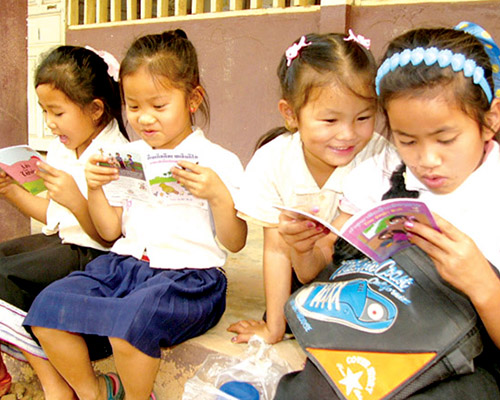
Literacy is a tremendous bargain. In our schools, nearly all children are reading in kindergarten or first grade. Our main tools: Two simple black-and-white books, teachers with basic training about how to use them, and hundreds more books that are fun and appealing, with a big selection for every reading level. (In public schools this is rare. Even by grade five, only half of children can read a simple Lao text.)
Sponsorships make these books possible. Thank you! Children are not merely learning how to read; they are developing the habit of reading, and an enjoyment of reading. There is no better gift you could give them.
And schools provide the place for it to happen. After they are built, our schools are self-supporting, because parents pay a modest tuition. But the initial construction can happen only with support from donors. Thank you to everyone who has contributed toward a school.
Thank you, as well, to those who make general "unrestricted" donations, for us to use as we feel best. Often, these also go toward book printing and school construction. Sometimes they make special projects feasible. This support made it possible for us to spend a year developing a sign language curriculum. Children enjoy learning to talk with their hands; many studies have found that sign language helps small children develop other language skills; and it reduces the isolation of deaf people. We also use unrestricted donations to develop and produce the games and activities that make our schools exciting and fun. They pay for occasional travel, so our teachers and staff can visit other schools both in and outside of our network to exchange ideas.