

We invite you to join an enthusiastic group of our overseas supporters, Lao schoolchildren and teens, and several of our staff to see and experience our active approach to education, which is changing the lives of thousands of children in Laos. The week-long trip offers:
• Visits to 4 of our schools. That's two Big Sister Mouse schools in Luang Prabang, which are run by Big Brother Mouse, and two Ton Kit schools a couple hours north. These were created by Siphone, who helped Big Brother Mouse get started and grow, then was so alarmed at the poor quality of schooling in his hometown area that he moved back, and did something about it.
• Time to get involved in each school, playing games, reading aloud in English, or doing other activities with kids. Children improve their English as they play "What Am I?" with visitors. Take turns asking yes-or-no questions, to guess what animal is on your forehead.
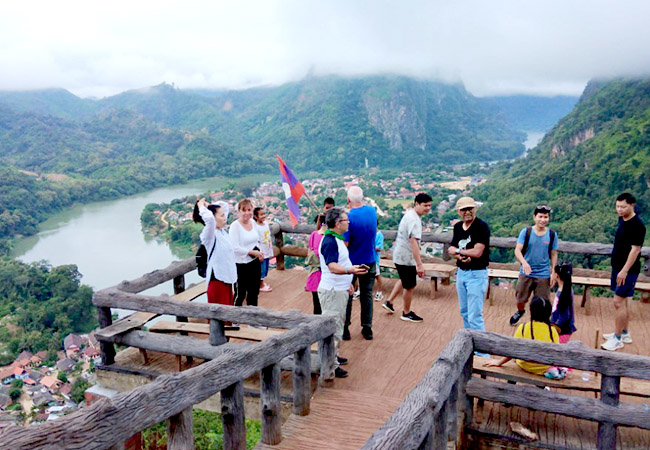
• Several side excursions, all optional: A short mountain hike to a scenic overview; a visit to a museum created by one of our former staff which displays the UXOs (unexploded bombs) dropped by the U.S. a half-century ago and which continue to endanger lives in the countryside; one or two visits to see traditional handicrafts such as weaving.
• Meeting other supporters. This trip draws a special group of people, who want to better understand the country, the people, and the challenges of providing good education in a developing country. You'll probably end up with some new friends.
• Getting to know us. Some of our students, ages about 10-13, and some staff will come along. The trip price helps to subsidize this, which is an exciting opportunity for them. Many visitors have commented that the children, in particular, make the trip very special.


Here's what we've done in the past and expect to continue. As with any travel plans, unexpected circumstances may require changes.
Sunday: We'll cross the Mekong River into Chompet district, for a pleasant 8-kilometer walk along a rural trail that takes us through the forest to a hilltop overview and several beautiful Buddhist wats. On rest breaks, you can try out some of our games, toys, puzzles, and other activities that challenge kids mentally or physically or both.
We typically come back early afternoon. However, there's a network of rural roads and trails in Chompet. If you want to explore more, it's easy to come back independently, earlier or later, by yourself. We'll have an evening welcome dinner.
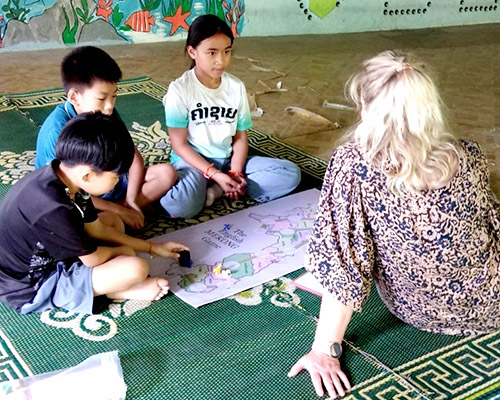
Monday: Visit both of our Luang Prabang schools and get brief training and practice with activities that you can do during the road trip. This includes games that help children learn English, geography, and math. Many of these are fun for all ages; you'll find examples on our activities page.
Limited time? Those with time constraints can skip the Sunday and/or Monday activities, and still take part in the road trip; just be here on time on Tuesday morning.
Tuesday: A 2-1/2 hour drive north to Ton Kit school in Hua Na village. Ton Kit is the creation of Siphone, who has been part of Big Brother Mouse since the beginning. We'll arrive in time to look around and meet some teachers and children before lunch, then 3 hours of afternoon activities with the students. We'll spend the night in a guesthouse nearby.
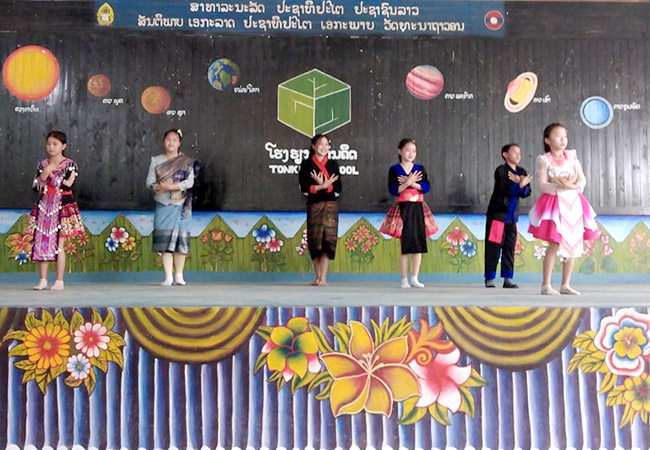
Wednesday: In the morning, we'll go to a nearby public high school where students are eager to see and enjoy Big Sister Mouse activities. After lunch, Ton Kit students will entertain us with a music and dance performance, followed by more games and activities. Then we'll drive one hour to picturesque Nong Khiaw (spelled Nong Khiao on some maps), a small resort town on the Nam Ou river. We'll spend three nights here. While a full schedule is planned, you're welcome at any time to relax at the guesthouse or pursue independent activities, such as renting a bike and exploring the area.
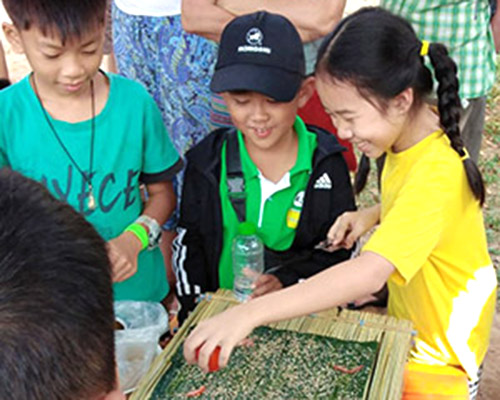


Thursday: A new school, Ton Kit #2, opened in 2023, about 20 minutes from the town. We'll spend the morning engaging in activities with students. In the afternoon we'll see traditional weaving in a nearby village. That evening, a boat ride on the Nam Ou river, under the cliffs and a starlit sky, takes us to dinner.
Friday: A 30-minute morning hike leads up the mountain to a scenic overlook. Then we'll visit the UXO museum to learn about the unexploded bombs (UXOs) from the U.S. bombing campaign of 1964-73, and visit a cave where many people lived during the U.S. bombings. Then spend the afternoon at the school or at the new Discovery World, created in affiliation with Big Brother Mouse and Ton Kit schools, on the bank of the Nam Ou river in Nong Khiaw.
Saturday: We'll have a few hours before we drive back to Luang Prabang. Relax with coffee and a book. Enjoy games and activities with others on the trip. Walk through the countryside. Learn some Lao sign language from our students. Then we'll have a farewell dinner in town.
February 21-27, 2027. $800 per person. Single-room supplement: $80. (All prices are in U.S. dollars.)
Group size is limited to 8 visitors.
Deposit: $200 per person.
This includes all 7 lunches and 7 dinners, and 4 nights of clean, comfortable, but not deluxe, accommodations on the road. Breakfast is not included except Wednesday morning, because other locations have a variety of spots nearby and we've found that visitors prefer flexibility about breakfast foods and times. Luang Prabang accommodations are not included because many people already have a favorite spot, there are choices in all price ranges, and it's easy to make reservations online.
Food: Meals feature dishes that visitors from abroad will enjoy, with largely local ingredients. We are happy to accommodate vegetarians and some dishes are usually meat-free in any case.
Full reservation details


When we opened our first school in 2016, we taught some simple Lao sign language. Children loved learning it! And it helps them develop other language skills. Because sign language is seen as a way for deaf people to communicate, the question naturally arises: How many children in Laos are deaf or hard of hearing?
Nobody knows. In the U.S., based on surveys in 1997-2008, the Centers for Disease Control reported that about 1 child in 220 was "deaf or had a lot of trouble hearing without a hearing aid." Most hearing loss is caused by childhood disease rather than being genetic, so in a country with a far weaker health infrastructure, the level will surely be much higher. Roughly 1 child in 50 or 1 in 100 in Laos would be a reasonable guess.
How many of those children are getting support so they can acquire language and fully communicate? Again, nobody knows. Our experience suggests it is very few. Sometimes the deafness isn't recognized; the child is assumed to be mentally slow. Or parents do know their child is deaf, but have no idea what they could do about it.
When we introduced sign language, we had these children in mind as a group that could greatly benefit, but only after we had a good system for teaching it. By September 2024, we felt we had something to offer, and we made inquiries in villages near our schools. The first replies were "no, we don't know of any such children here." We continued asking. Four months later, we identified a deaf boy just a few kilometers from one of our schools. He enrolled in January.
What happened? He cried a lot on the first day. Many children do. Within a couple days he was happily playing with the toys. A week later he was playing with new friends. One of his teachers is deaf and he has begun learning simple signs, along with his classmates.
Previously, we thought we'd have something to offer to children who are deaf or very hard of hearing... but we weren't really sure. We still aren't certain but we're encouraged. He is happy, his parents are very grateful, and we're continuing to spread the word that if your child has hearing loss, we believe we have something to offer.
Meanwhile our other students, whether they have a deaf classmate or not, get the benefits of learning sign language. They enjoy it, and studies indicate that it reinforces other language skills. This is win-win all around.