Education is not the filling of a bucket but the lighting of a fire. That's what the proverb says, and here's one way we do it.
Our schools use more than two hundred types of games and puzzles to challenge our students, help them learn, and get them excited about it. Some of these we buy, some we've invented, and for some we've gotten ideas from elsewhere and adapted them for our purposes and language. (Big Brother Mouse schools are in Laos, games generally use Lao language when a text is needed, but some also have English, and many don't need language at all. Each listing tells more.)
As time allows, we're making modifications so these games can more easily be used elsewhere. Here's what we have so far. We'll continue to add others.
Lay out 9 numbered cards in a 3x3 grid. Now, as fast as they can, everyone tries to find an equation which combines 3 or more cards with the standard math operators (plus, minus, times, divided by). If they succeed, they collect those cards and new numbers are put out in their place.
We have easier decks (1 to 10; just for addition and subtraction) and harder ones (0 to 100; and another with negative numbers). Pick the one that's best for your group.
Mouse Math cards negative 10 to 10
Here's an enjoyable way to develop a skill that doesn't appear on many "essential life skills" lists, although it should: Having a good grasp of how much you actually know, and how much you don't. The rules are simple: One person asks a question which has a numerical answer, such as:
• What is the population of Vietnam?
• What is the distance from New York to Paris?
• What is the oldest age ever known to be reached by an elephant?
Every player writes down not one answer, but a range of numbers that they believe includes the right answer. Then these get divided into two groups. Group 1: Those who DID include the right number. Group 2: Those who did NOT.
Entries in group 1 are arranged in order, with those who gave the smallest range going at the top. Everybody in that first group gets a point for each answer in the second group, and also a point for each answer in the first group that ranks below them. Those in the second group get no points for this round.
This is one of many games described in Ben Orlin's superb book Math Games with Bad Drawings. He suggests that players each find a good question and take turns calling it out. This 9-page PDF can be printed and cut into cards, producing about 290 questions to get you started. Then, by all means, add your own.
The Estimation Game, 9-page PDF in English
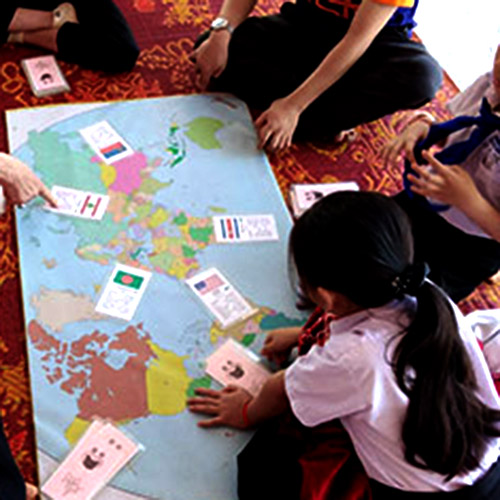
Scientists use eight taxonomic ranks to categorize animals: From domain and kingdom, down to genus and species. With this game, you'll gain some basic familiarity with what they mean.
Each of these 110 cards has an animal picture on the front, and the six animal-related categories (starting with phylum) on the back. Spread out some cards face up, then everyone tries to pick the pair that they think are most closely related – that is, which match up furthest along the list. Be careful! Sharks and dolphins look similar, but they are far apart on the family tree.

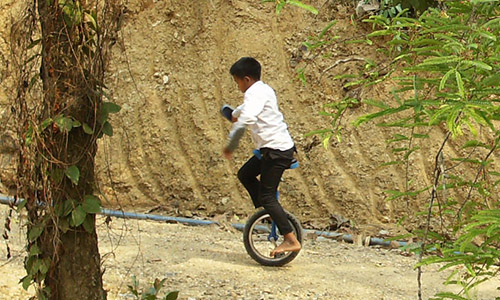
Visitors sometimes ask: Why do you have unicycles?
Because kids have fun on them. That's reason enough. Children are required to attend school, but that doesn't mean it needs to feel like a prison!

There are other good reasons, as well. When a child first sees a unicycle, they're likely to think "that looks impossible to ride."

When they first try, it feels impossible. But after a few tries, it starts getting a bit easier. Soon, they are hopping on and off, riding around as easily as if they were walking. Soon they're trying new things, going over a bump or down a ramp. One group of boys all tried riding backwards one day. They were able to do it but soon stopped, for precisely the reason that you probably already thought of.

We have unicycles because now students see something that looks impossible, but soon they learn to do it. And they learn it by themselves, perhaps with a little help from their friends. That's every bit as important as any other lesson they will learn.