

In 2016, after 10 years of publishing books intended to "make literacy fun," we grew concerned that most children in the public schools couldn't read these books. And literacy levels were getting worse.
So we opened our first school, just outside of Luang Prabang. It was small: Just 13 students in grades 1 and 2. One student was an 11-year-old boy who had finished primary school but couldn't read, so his mother enrolled him in our second-grade class. Six months later, he was reading books in his spare time.
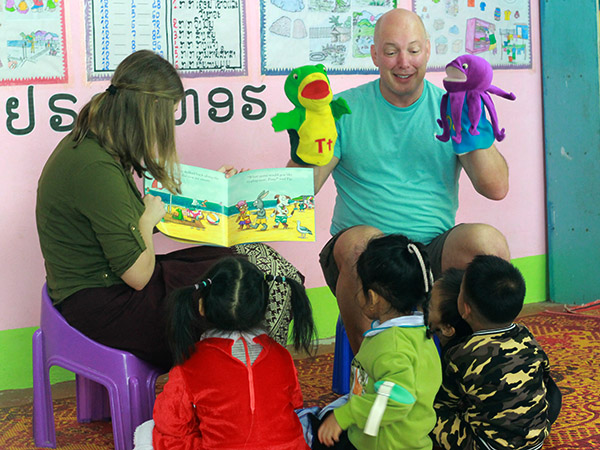
Our philosophy was to get children excited about reading. We read stories aloud. We show them there's something fun in those books. It works. Those 13 children all learned to read that first year and parents said, "Please! Do more!"
We've now got 9 schools in northern Laos, with 3500 students. They learn not just reading but also math and geography. They learn no just school subjects but also life skills: Problem-solving, cooperation, taking initiative, handling responsibility, and critical thinking. And, a factor often overlooked by school administrators worldwide but every bit as important: They're happy.
We offer three ways to actively participate in these schools.
A day at Big Sister Mouse in Luang Prabang: If your time is limited, a day at our school on the outskirts of Luang Prabang lets you see what we do, help us do it, and meet a lot of kids. It's not a real long day: Leave at 9:00, back before 4:00.
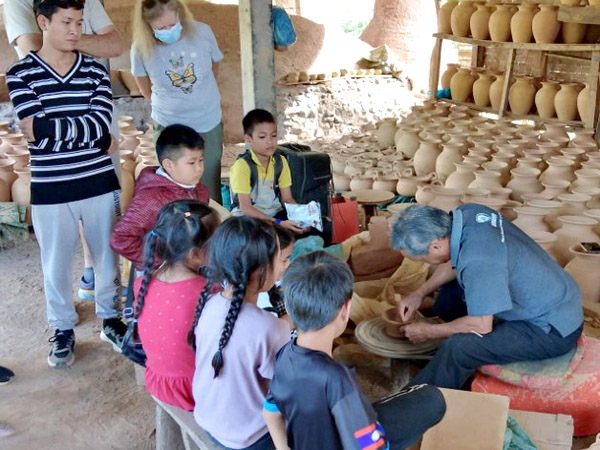
Nong Khiaw trip: Spend time at four of our schools. We'll have two days in Luang Prabang (optional, if your schedule is tight.) Then we drive north about two hours to see Ton Kit School #1, a bustling center of activity for 800 students. We spend one night at a guesthouse there, then three nights in the small resort town of Nong Khiaw, not far from Ton Kit #2, where our time will be divided among activities with the students, sightseeing to a local weaving village, and a cave where villagers took refuge during the decade of U.S. bombing.
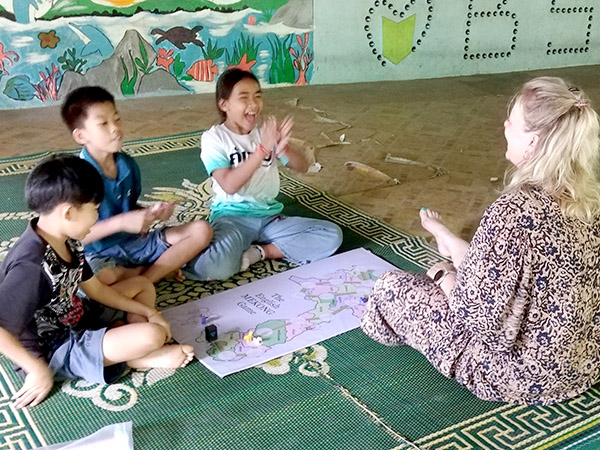
Little Rabbit visit: This consists of a relaxing full-day boat ride up the river to our most out-of-the-way school, then three days in Muang Houn, interacting with students through games and activities. For most students, our visits are their only opportunity to see and interact with people from abroad, and it's an exciting time for them. We'll also have opportunities to see some local handicrafts.
The heart of each trip is engaging in activities with students, such as these:



Ever since motorbikes became widely accessible, walking has fallen out of favor. Not just in Laos; that's the trend worldwide, whether because of motorbikes or cars.
But just as children are eager to learn, and have an instinct to acquire language, they also naturally love walking. It's good for them. It builds up a healthy lifetime habit. It helps them develop a love of nature.
Soon after we opened our first school, we tried something ambitious: Walking along the unpaved road in front of our school, 2 kilometers of level road then another 4 kilometers uphill, where the van met us and brought everyone back. Some children were so exhausted they fell asleep on the ride back. But a week later, they were eager to do it again.
Everyone at the time talked as if that had tested the limits of human potential. But within a few months we had a new route: Up the same hill, along a ridge and past a strawberry farm, a lunch stop, then down a trail through a fern-filled forest, stopping at a small waterfall with a swimming hole, briefly along a not-too-busy highway, then to the Hmong village of Kua Ti Neung and back to the school. A 12-kilometer circuit.

We've found more routes: An 8-kilometer trail from a dead-end road in the mountains leads down to Kwangsi waterfall, which you probably visited (via an easier route) if you ever came to Luang Prabang. An 8-km round trip, on the other side of the Mekong, that takes us to a remote, beautifully-landscaped Buddhist temple.