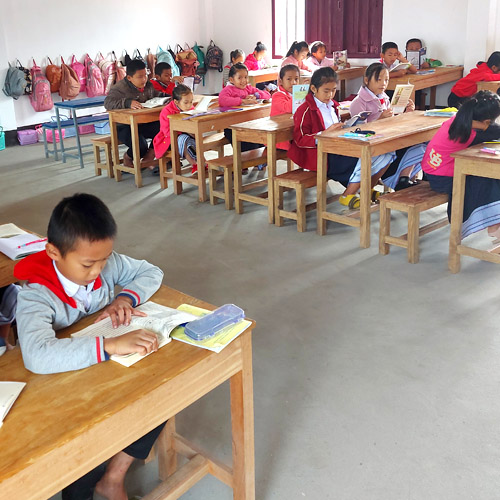
Founder and Director: Siphone Wuttisakdy
Location: Huana Village, Nambak District, Luang Prabang Province
Opened: September 2019
Classrooms: 25
Enrollment: 825 students
Grades: Preschool to high school (level 4, about age 14)
Location: Phonsaart Village, Nambak District, Luang Prabang Province
Opened: September 2023
Classrooms: 10
Enrollment: 295 students
Grades: Age 2 thru grade 5
Location: Sang Village, Nambak District, Luang Prabang Province
Opened: September 2025
Classrooms: 4
Enrollment: 93 students
Grades: Preschool, ages 2- 5
Siphone Wuttisakdy was born into a loving family in a remote Lao village that had little of what is taken for granted in many countries: No running water, no electricity, no road, no school. When he reached school age, his family moved to another village so he could attend school. He learned to read in grade 1. After primary school he moved to Luang Prabang and became a novice monk. Here he met another novice, Khamla Panyasouk. They became good friends at the Monk School, and later entered Teacher Training College together.
 A mouse is born
While in college they met Sasha Alyson, an American who suggested that a small publishing project could write and publish "books that make literacy fun" for Lao children who often had never seen a book, and certainly not one that was fun. Siphone, Khamla, and Sasha wrote some of our earliest books. Siphone wrote down stories he had heard from his grandparents. That became The Cat That Meditated, one of the first books published by Big Brother Mouse. Today it has 53,000 copies in print, and he has written nearly thirty more books. (Photo: Siphone with You-Know-Who in 2006, the year his first book was published.)
For the next decade, Siphone was a key part of Big Brother Mouse, with a can-do spirit that repeatedly showed itself as we broadened the scope of what we published (his book Why Do My Chickens Die? was particularly popular with farm families) and worked to get books into hard-to-reach places.
Even in their remote villages, Siphone and Khamla had learned to read in grade one. But as we went into schools, we found few children even in grades two and three who could read. Not in rural villages, nor in towns. Despite years of U.N. and NGO activity (some would say because of that – U.N. goals have emphasized enrollment rather than learning), reading skills were getting worse. In 2016 we opened our first school, Big Sister Mouse. Siphone became the school director. This was all new for us. We knew that existing systems weren't working, but we had no experience of our own to draw on. We had to try new approaches, observe what worked, and decide what to keep, what to improve, what to drop.
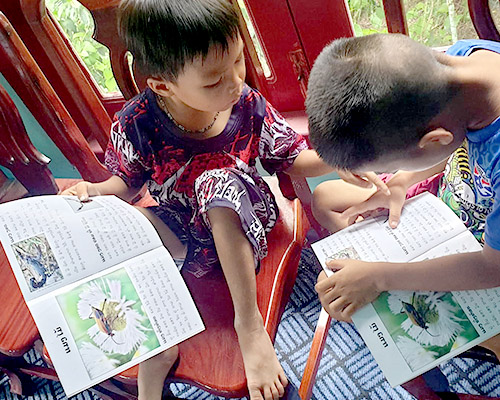
We had already created a series of learn-to-read books, with colorful pictures and very short text, in a step-by-step progression. Siphone put those to good use, but also discovered that what we intended as a supplemental book had more value than we'd first realized.
 The worst children's book ever published
This book, by all the usual definitions, was the world's worst children's book. It was black-and-white. It had no pictures, no characters, no story. It consisted merely of lists of rhyming words, each list headed by a bold-faced word that rhymed with those below.
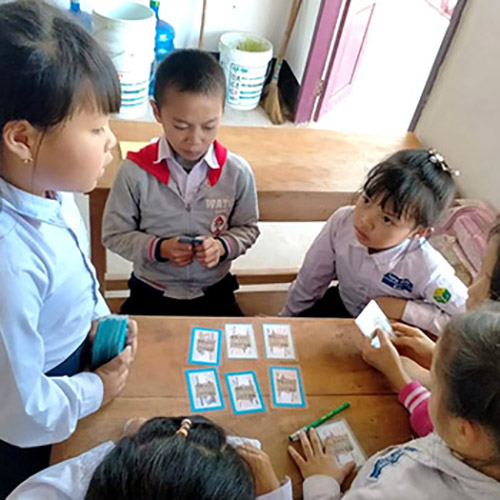
But it worked. And we still use it. Our philosophy is that first, we get children to want to read. We do that by reading aloud from storybooks. And they learn the alphabet. Lao is phonetic, so once they can read the headword of each list (for which they may need help from a teacher or student), they can swap out the first sound for a different one, and read a new word.
It still seems counter-intuitive that a drab word list would be so effective. But Siphone saw that it was working better than we'd anticipated. At this point, children want to read. Now, they're realizing, "I can read!" That excitement keeps them going. Soon they've passed beyond this stage, to reading books with content.
As the 2017 school term opened, Siphone went to visit his parents... and unexpectedly came back with his nephew, who lived near them. The boy was about to enter grade 4, and couldn't even read his own name. He stayed with Siphone's family and attended Big Sister Mouse.
The first few weeks were hard on everybody. He hated school; it felt like a prison, and he lashed out. At one point during his early days he indignantly said, "Well, in my school, we can have fights during class if we want to." But he soon realized that our school was different. Within about five months, he not only had learned to read, but sought out ways to be helpful.

Siphone resolved that more children should benefit from our approach. The next year he moved to his home region and built Ton Kit school. It opened in September 2019 with 10 rooms. They immediately filled, and he began adding more.


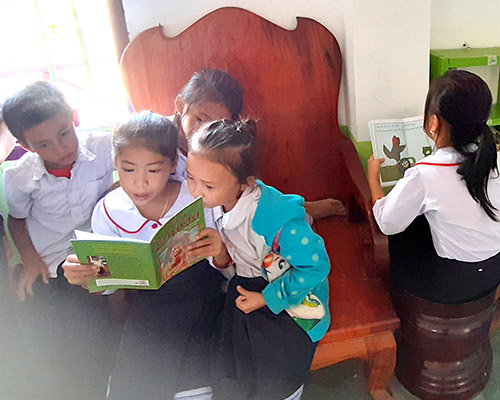

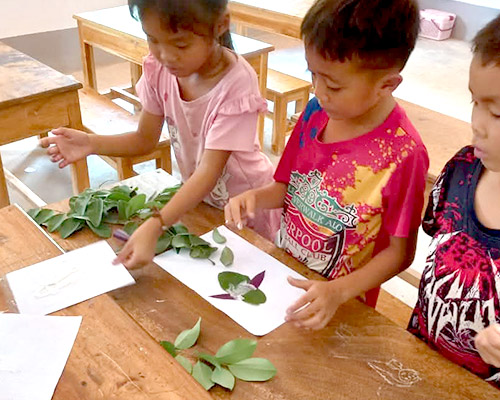
Building a school is the expensive part, but not necessarily the hardest part. Creating good-quality education inside and outside those walls is a long and challenging process. Most new teachers arrive with no experience having seen any model except that of a teacher at a blackboard, telling students what to remember for the test. We are continually developing ways to get students more engaged, and helping teachers appreciate that play, independent problem-solving, physical activity, group activity, and reading, are all key elements of quality education.
For more than two years, the pandemic closings slowed everything down, but Siphone has continued to work tirelessly to make good schooling available to more children. As soon as restrictions were lifted, he began construction of a second school, Ton Kit #2, in Nambak, the district capital. It's about 40 minutes from Ton Kit #1, not far from the small river resort town of Nong Khiaw.
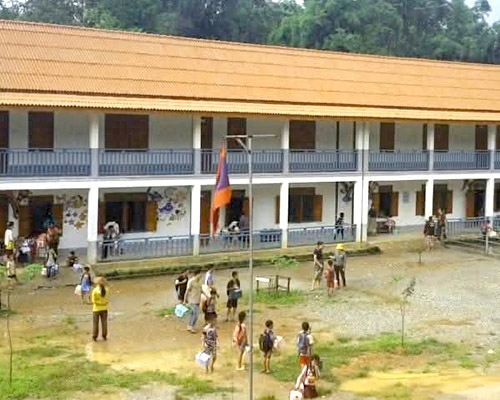
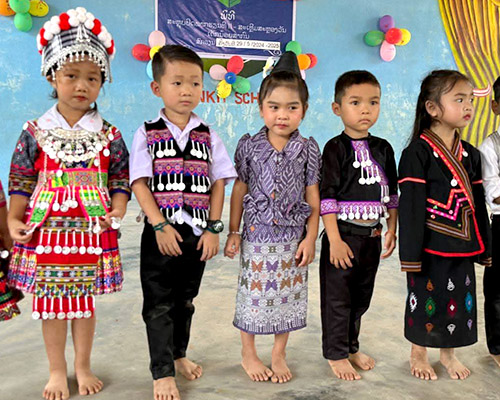
That didn't help with the cost of construction. But with generous support from donors, Siphone was able to accept the land offer. As a result, about 90 more children will have their lives enriched at a school that develops their minds and bodies and spirits.
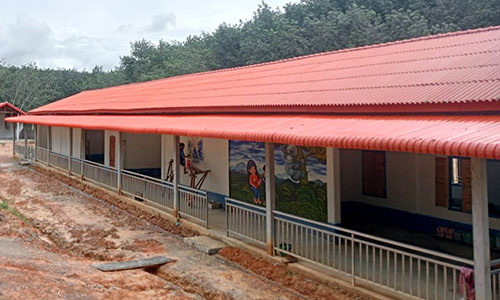


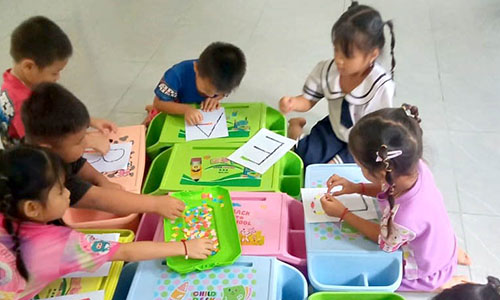
From all of us, and especially from the children and parents, thank you to the donors who made Ton Kit #3 possible: Emily Benz, Chuck Locher, Sasha Alyson, Bruce Schaller, Howard Clausen, Gabriel Smith and Phone.

Our Little Elephant preschool opened in Bokeo province in September 2023. There was a clear need: Like everywhere else we've opened schools, too many children were finishing primary school unable to read. But another crisis has been developing as well.
Among the new children was a 4-year-old boy who could understand Lao, and whose family spoke Lao, but he did not. He was mostly quiet, and occasionally "babbled" in a way that no one could understand, but which didn't sound at all like Lao.
Sherlock Holmes might have been stumped by this one, but the school staff soon identified the problem: At home the boy spent all his time on a mobile phone, watching cartoons or playing video games. He got almost no practice talking, or making himself understood.
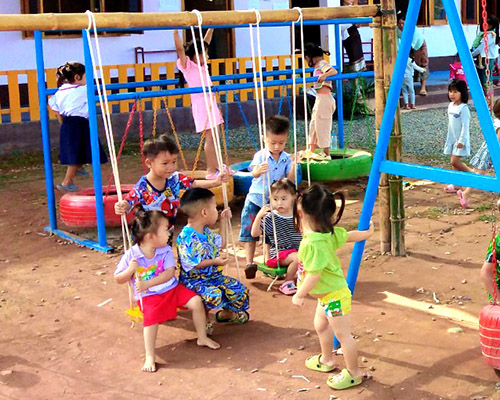
Our schools do not allow children to use mobile phones. After six weeks of interacting with real people (the Little Elephant play area is shown here), he showed improvement.
Another of our schools, Little Rabbit, opened at the same time in a different province. Phon, the founder and director, noted that six years ago mobile phones were new in that region and parents happily allowed their children play on the wonderful modern toy. But by 2023, he said, parents were increasingly alarmed. Their children were skipping meals, didn't play outside, and had no friends. All they did was play video games and watch cartoons.
The solution may seem crystal clear. But if you take away the phone, the child will scream bloody murder and throw a tantrum. The solution seems crystal clear anyway, doesn't it? But let's remember that the human race is heading for climate disaster, rather than deal with short-term inconveniences. There's no easy solution in sight, not on toddler phone addiction, nor on global oil addiction.