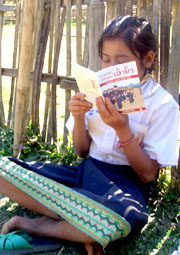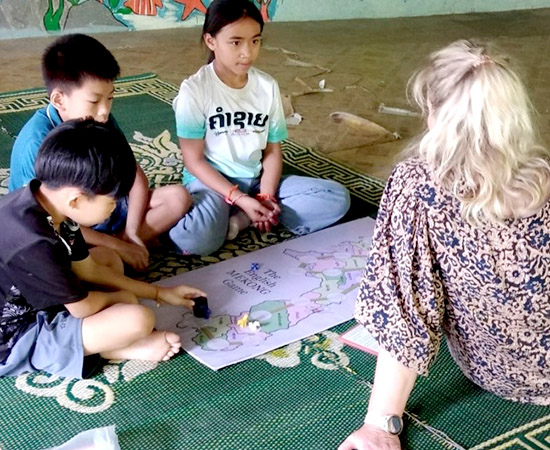

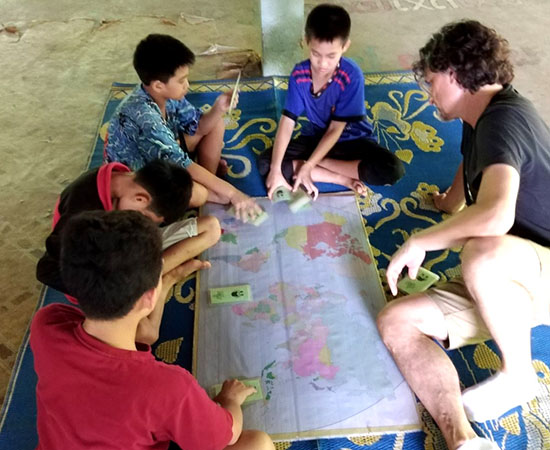

From our very first year, 2006, we saw that getting books into the hands of children would be an even greater challenge than publishing the books, and we held our first book party. In the years that followed, we've held thousands of half-day book parties in rural Lao villages, giving hundreds of thousands of children their very first book.
Now we've adding a new twist. In our 9 schools, with 3500 students, we've shown that education can be far better, and also more enjoyable, than it is in most public schools. We've begun holding half-day book parties, not only to get children enthused about reading, but to help committed schools and teachers improve education. Here are details of our book parties.
Are you coming to Luang Prabang? If you've supported our work by sponsoring a book party (US $300-$400) or with another donation of comparable size, we're eager for you to see what you've made possible. But we ask you to sponsor a book party or other activities because you want children in Laos to get a better education and to learn the pleasures and benefits of literacy. If it is possible for you to attend an event, please think of that as a bonus, and note the following:
• We are not a travel company; we are not selling tours. If you do not wish to donate unless you can be certain of attending an event, then we're sorry, but we cannot accommodate such requests. We suggest one of our multi-day trips to see schools and take part in activities; or you can arrange a briefer village visit with a tour company.
• From the third week of September to the end of April, except for special dates noted below, we can usually have an event in an accessible village on Tuesdays and Thursdays, if we know in advance that a donor will be here and would like to attend. If you're here on one of those days, we hope you'll be able go with us on this trip, which typically departs at 12:30 a.m. and returns between 4:00 to 5:00 p.m. (Please have an early lunch. We'd prefer to have a later start, but with travel time, that wouldn't leave as much time as we need at the school.) This is usually a book party at a rural primary school, but based on school schedules and other considerations, it may consist of similar activities in another location.
• We generally do not hold school book parties during the major holidays, particularly the week of Lao New Year (mid-April), 1 January, 8 March, 1 May, or 2 December. During school finals and summer (May; last half of January; early September) we hold only a few. Other special events and school tests sometimes limit us.
• Our schedule is not planned long in advance and often changes, so we regret that it is not possible for us to answer questions about where we will be on certain dates, or whether we can arrange a party for you to attend on a specific date if you make a donation. We cannot try to arrange for you to join us at an event unless we have already received the donation from you.
• When you make your donation, or afterwards, let us know the dates that you expect to be in Luang Prabang, and that you would like to attend the party. Most villages are on a road, but please tell us if you can make a trip that requires some walking, and how much (from 15 minutes to 1 hours).
• Travel plans often change, so please email us about 2 weeks before your arrival to reconfirm your interest. As soon as we can, we'll let you know what we've been able to arrange. Typically, we plan events about 3 to 8 days in advance.
• We cannot take requests to go to a specific village; we conduct these in village groups selected with the Department of Education.
• If you donated some time ago, but are only getting to Laos now, no problem, you're still in our records and we'll be happy to have you join us for an event if possible.
Below: Book parties are fun for everyone: students and teachers, staff and visitors. Many sponsors have reported that for them, the very best part is after it's over, as they watch dozens of children enjoying their new book.
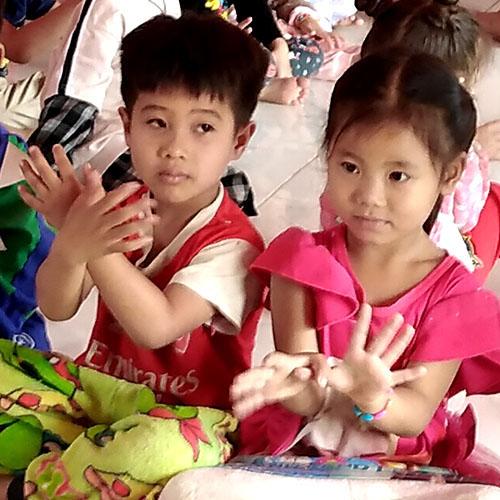
People often ask why we are eager to introduce sign language to children. We have many reasons.
• If a student meets someone who uses sign language, they can communicate.
• In Laos, many children who are deaf never have an opportunity to learn sign language. Often they're dismissed as not-too-bright. A wider awareness will help change this.
• Children are eager to use their fingers and hands. And they have an instinct for learning languages. It's a natural fit at this age.
• There is evidence that learning sign language helps small children learn to read, as they begin to think about individual words.
• And children love it.
The question should be, why isn't sign language taught to young children everywhere?