
In 2006, Big Brother Mouse began publishing fun, easy books for children. We took them to schools in the countryside. But most students couldn't read them. Schools were failing.
So we began creating schools that work. We now have 12 schools with 4200 students. They learn to read in kindergarten or grade one... and they soon read with enthusiasm! They learn other subjects such as math and geography. Even more importantly, they develop the broader life skills that we consider essential: Problem-solving, taking responsibility, com-munication, planning ahead, and much else.
Currently, all our teachers attended rote-based schools. We've trained them in more active, engaging techniques, but changing long-established assumptions is a slow process.
To address that, we are planning something different from anything we've ever heard of.
It will be a high school for young people who want to become teachers. Many of them will come from middle schools in our network: Big Sister Mouse, Ton Kit and Little Rabbit. These students will already appreciate our active approach to learning. We'll also welcome students from other schools for whom our methods will be new, but we've already seen that teenagers with an interest in education, quickly welcome the opportunity to learn better ways. At this high school, students will:
• Study and discuss ideas about how children learn best. For years, we've been compiling articles, essays, and videos that explore this. Now we'll have a time and place to put all that to extensive use.
• They will themselves get experience learning through activities, discussion, experiments, reading, and other projects.
• This will be our first upper-level high school. We still need more activities for this level, and one project for students will be developing them.
At the same location, we'll have a preschool, primary school, and middle school (ages 11-14). There, our high schoolers will get hands-on experience working with younger children.
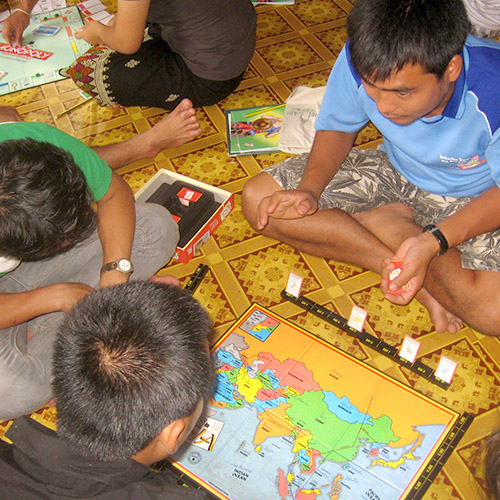
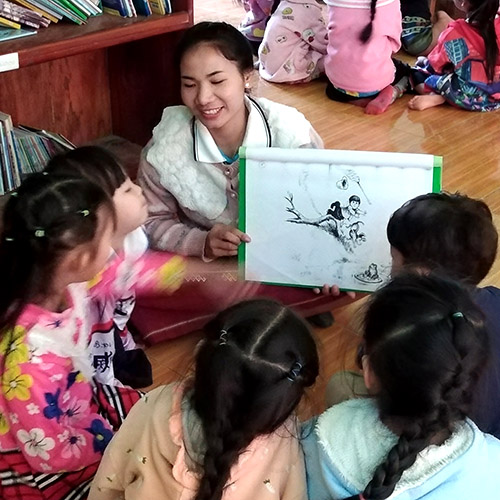
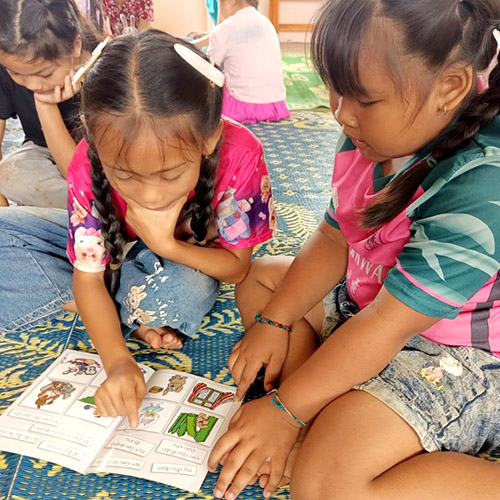
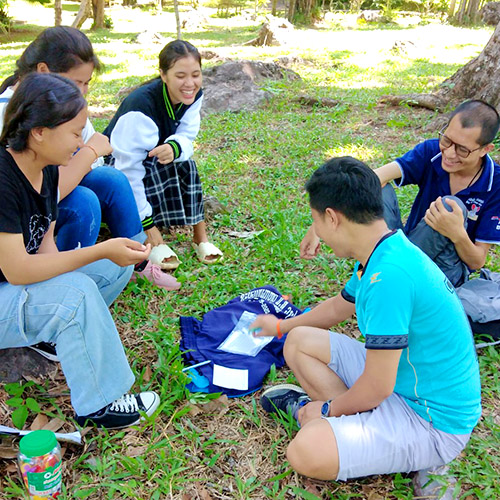
In the decade since we opened our first school, we've developed over 150 games and activities that make school exciting for children, while helping them learn more. Here's a sampling. Future teachers will learn these at Uncle Mouse school.
But we don't have to wait for them to graduate and start teaching. Children enjoy helping each other learn. They are proud to help, and they develop a sense of responsibility that will last a lifetime. In the past, we've occasionally brought small student groups from our other schools to our Luang Prabang school for a week in which they learn and enjoy selected activities, then return to teach them in their school. It worked. But we could accommodate very small groups, on an occasional basis. At Uncle Mouse, it will be an ongoing activity.
We opened our first school in 2016. Now we have 12 schools.
Each of these was possible only with support from donors in wealthier countries, who wanted to help children in a poorer country get a better education and believed that we could do it. We asked for help; generous supporters gave it; and we built the schools. And all but one were finished on time or earlier; one was delayed by an unusually heavy rainy season that brought a halt to outdoor construction, but it is now open, and full.
We intend to open this school in September 2027. We can do that, with your help. A donation of US $8,000 will pay for a classroom; any amount of $2,000 or more can be designated for this purpose. Will you help? Details are on our Donations page (please see main menu above).
From us, from the future teachers who will change education in Laos and from the children who will benefit: Thank you.
Will you help us build a new school?
We realize that you have plenty of choices about where to donate. In making a deci-sion, we ask you to consider the difference between charity and development.
It's been defined like this: Charity offers short-term relief for people who lack food, health care, good education, or other basics. It feels good, but it doesn't address the real problems. It builds dependency.
Development makes it possible for people to solve the problems themselves.
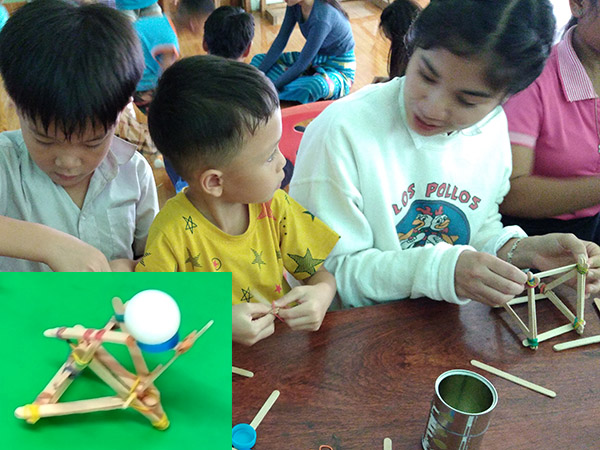
At our schools, we look for ways to help children think for themselves, try new ideas, evaluate results, and solve problems. For example: Making a toy catapult from wooden craft sticks, rubber bands, and a pingpong ball. We show children a functioning model, then take it away and let them experiment on their own. They try various ideas, discover problems, and experiment with solutions.
On a very small scale, this is what life is about. Whether you start a business, work in government, or conduct medical research, you need curiosity to solicit ideas, thoughtfully try new ideas, see what works, and plan what to do next. People who get charity are more likely to spend their time thinking about how to get more charity.
Our focus is on helping Lao develop. After they are built, our schools become self-sustaining. They are run by Lao people who continually look for better ways to improve education. They provide jobs and experience for Lao teachers, administrators, and staff, and quality education for Lao children. They are creating a generation able to build the Lao institutions that will make our country strong.
But we cannot take this vital next step without help for the initial construction. Will you consider a contribution to make this possible? Thank you.