


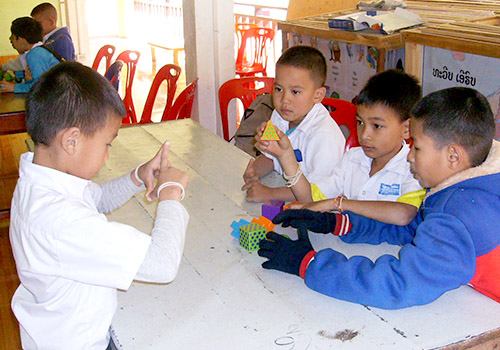
When we opened our first school in 2016, we had two people on our staff who were deaf. They taught some basic sign language to children, particularly animal names. (For mosquito pinch the back of your wrist, then slap that spot.) "It's fun!" was the nearly universal response.
Visitors sometimes ask why we teach sign language. Lots of reasons – more than may be obvious at first.
• If they meet someone who uses sign language, students are more likely to be welcoming rather than feel there's an unbridgeable gap. That's benefits everybody.
• In the countryside, many deaf and very hard-of-hearing people never had an opportunity to learn sign language. Often they're assumed to be mentally deficient. ("Deaf and dumb" was once a common English term, and it's still all too common.) A wider awareness of deafness and sign language is one step toward addressing this. Some of our students may one day create initiatives to help make sign language more widely taught to children who will benefit most from it.
• Children like using their fingers and hands.
• Learning a new language brings many benefits. This is even more true of sign language than a spoken language, because the physical component activates other areas of the brain.
• Studies in the U.S. (reported in the book Dancing With Words) have shown that learning sign language gets small children ready to read, in part because it helps them grasp that speech consists of individual words.
• We're not sure, but it seems that because people look at you more closely when you're speaking with sign language, it can help children gain more self-confidence about speaking or performing in front of others.

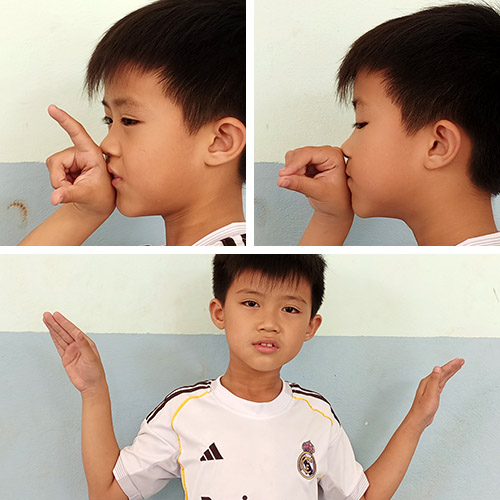


Children love learning sign language, and sharing it with others. The pictures above are for the words airplane, bird, cow, grass, preschool, rabbit, sunshine – but not in that order. And because we think the best education includes challenges, we've added a seventh word to this list, which isn't in a picture. Can you guess which is which? Use the English page of our Lao Sign Language dictionary to see how you did.
Learn some sign language with us! Our site is mostly in Lao, but with both Lao and English word definitions. Get started with an introductory page in either language
Overview in English
Overview in Lao
After teaching some simple sign language during our first years, we decided to develop a curriculum so that children can carry on a full conversation by signing. They learn a few words, practice using them in sentences, then learn a few more.
We want to hire deaf people, who are fluent in sign language, to teach it. But there are relatively few people who know it well, and often they don't want to relocate to the schools that need teachers.
So our teachers, and some highly enthusiastic students, have done much of the teaching, even as they themselves are learning. But sign language doesn't lend itself to lessons and photographs in a book It is best captured on video.
Our Lao Sign Language web pages, created to support our teachers and students, can be used by anyone. We're up to lesson 30 at this writing (October 2025), and we're steadily adding more. The written text is mostly in Lao, but the heart of these pages is the hand signs. No Lao is needed. Definitions and descriptions of signs are given in both Lao and English.
If you're interested, please take a look! You'll be pleasantly surprised how much easier it is to learn sign language than a spoken foreign language, and you may be inspired to begin learning the sign language used in your country.
Our Lao sign langage pages are designed to be used on a phone, which we expect will be the almost universal way they are viewed in Laos. The link is at the top of this column.