Founded and run by Big Brother Mouse
Director: Phonesavanh Phanthavong
Location: Nasai Village, Luang Prabang District and Province
Opened: September 2016
Classrooms: 24
Enrollment: 705 students
Grades: Preschool to high school level 4 (about age 14)
Director: Sonsai Intasai
Location: Xiang Lek Village, Luang Prabang District and Province
Opened: September 2019
Classrooms: 9
Enrollment: 307 students
Grades: Preschool and primary school, grades 1 to 5
Director: Souksavang Onmanisone
Location: Xieng Ngen Town, Xieng Ngen District, Luang Prabang Province
Opened: September 2024
Classrooms: 8
Enrollment: 294 students
Grades: Preschool and primary school, grades 1 to 5.
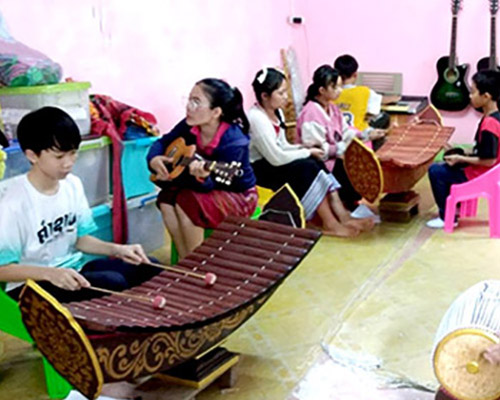
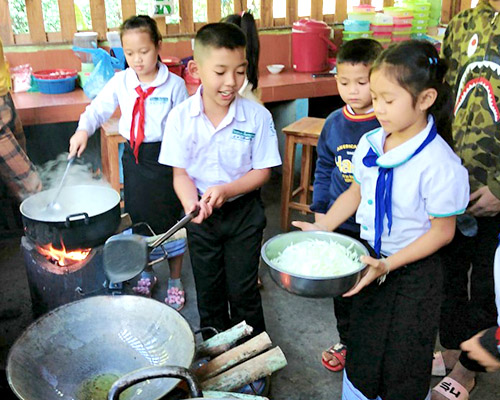
We opened our first school, Big Sister Mouse, in 2016. Today it offers preschool for ages 3 to 5, plus five years of primary school and four years of middle school. But it's not like most schools in Laos. We get children engaged. We have a strong focus on reading, and we make school enjoyable.
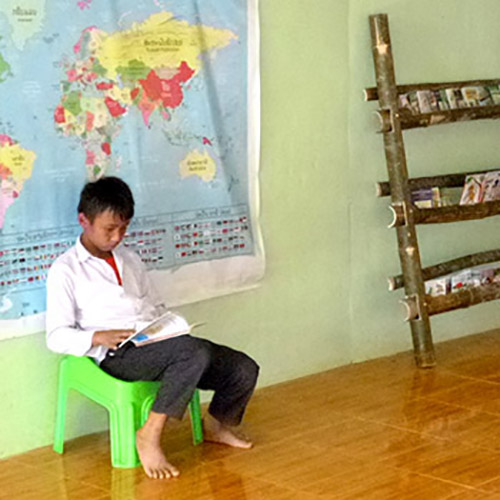
It works: Nearly all our students can read by the end of first grade. Some are reading in kindergarten. More importantly, they develop a love of reading. And the desire to learn, which all children have naturally, is nurtured rather than crushed with rote memorization and drills.
A nationwide assessment in 2019 found that most children entering grade 5 (about age 10) in Laos could not read a simple Lao text. We use many techniques to get children reading, but most crucial is this: They want to read. Teachers read stories aloud, so kids know there's something good in those books. Then, we teach young readers themselves to tell stories in an engaging manner. Now younger children have a role model, as well as motivation. Namping was in our grade 1 class during our first year. The following summer, she was reading our 200-page Lao adaptation of The Prince and the Pauper.
Visitors from other countries are part of the magic. By playing games with visitors, despite having little or no shared language, students improve their skills in math or geography, and also pick up some English because they hear it, in context, from the visitor.
Visitors come to the school for a day to participate in varied activities with students: Read a story aloud. Play "What Am I?" in which everyone uses simple English questions to guess what animal is on their forehead. Play "Hop Home": You read a sentence such as "Walk like a turtle," students show that they understand by doing it. More about volunteer opportunities
New teachers at our schools don't arrive with the skills for this style of learning. They spend an apprenticeship period, ranging anywhere from a month to a year, during which we help them develop everything from basic skills such as reading with comprehension, math, computer use, and English, to important life skills such as problem-solving, and group cooperation. Gradually they are integrated into classroom teaching.
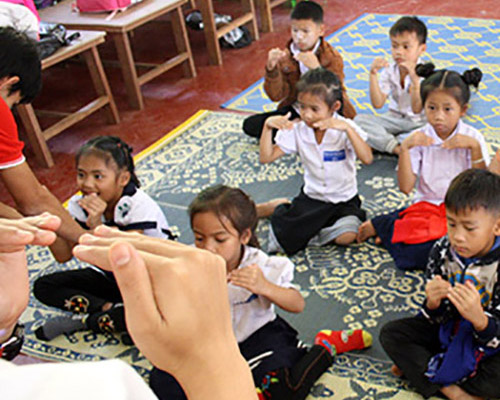


When we opened our first school, we had two staff members who were deaf. We taught some simple Lao sign language to children and they loved it. A fluent signer teaches others (first photo), then enthused students often teach one another. We've expanded the sign language program, and we're developing a curriculum so that those interested will be able to carry on a full conversation.
A modest tuition fee (about U.S. $18 to 22 per month) covers salaries and basic day-to-day expenses, but it does not cover extras like field trips, bikes, and musical instruments, nor construction. We're ready to build four new classrooms at BSM #1 so that more children can benefit from an affordable, quality education. Will you help?
Donations are tax-deductible, as allowed by law, in the U.S., Australia, New Zealand, and Switzerland, and qualify for Gift Aid in the U.K. Our Donations page spells out the options. Thank you for considering this!

Ever since motorbikes became widely accessible, walking has fallen out of favor. Not just in Laos; that's the trend worldwide, whether because of motorbikes or cars.
But just as children are eager to learn, and have an instinct to acquire language, they also naturally love walking. It's good for them. It builds up a healthy lifetime habit. It helps them develop a love of nature.
Soon after we opened our first school, we tried something ambitious: Walking along the unpaved road in front of our school, 2 kilometers of level road then another 4 kilometers uphill, where the van met us and brought everyone back. Some children were so exhausted they fell asleep on the ride back. But a week later, they were eager to do it again.
Everyone at the time talked as if that had tested the limits of human potential. But within a few months we had a new route: Up the same hill, along a ridge and past a strawberry farm, a lunch stop, then down a trail through a fern-filled forest, stopping at a small waterfall with a swimming hole, briefly along a not-too-busy highway, then to the Hmong village of Kua Ti Neung and back to the school. A 12-kilometer circuit.

We've found more routes: An 8-kilometer trail from a dead-end road in the mountains leads down to Kwangsi waterfall, which you probably visited (via an easier route) if you ever came to Luang Prabang. An 8-km round trip, on the other side of the Mekong, that takes us to a remote, beautifully-landscaped Buddhist temple.