|
Who writes and illustrates the books?
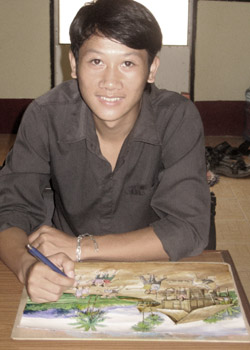 We'll start with the simplest part of the question. Laos has many talented artists. We've held two art contests at the Children's Cultural Center in Luang Prabang. The winner of each contest has now illustrated several books for us. In our office, we're building a small library of art books, which our staff uses to get new ideas and improve their techniques. Visiting artists also sometimes offer suggestions. Nearly all of our illustrated books contain art by a Laotian. (The exceptions are a few books we've reprinted from elsewhere.)
Skilled writers are harder to find. People learn to write a good book by reading good books, by writing a lot, and getting feedback on their writing. None of that happens routinely in Laos. By publishing a variety of books, we'll help improve that situation. In the meantime, we have developed a mixture of sources for books:
* Local Lao writers, especially college students, have written traditional stories, alphabet books, and other
beginner-level books. Some have gone on to write books for older readers.
* We've adapted and translated some works in the public domain, such as Dr. Dolittle, Sherlock Holmes, Pinocchio, and The Wizard of Oz. We worked with the Anne Frank Foundation to publish a Lao edition of Anne Frank's Diary of a Young Girl
* Some books have been written for Big Brother Mouse by non-Laotians, including Sasha Alyson, who founded the project, and Jane Burren of Australia, who has helped us with whatever we need.
* We've translated and reprinted a beautiful story, Wolf Mountain, that was originally published by Domrei Sor, a literacy organization in Cambodia.
* Another excellent book, The Monk and the Trees, was published in Laos in 1999 by a French organization, CIDSE. It was out of print for several years, and we received permission to reprint it. Several other good books have been published in Laos over the years; we have brought some of them back into print, and we're working on others.
In short, we're getting books from many sources. This helps us achieve our goal of showing the full spectrum of what books can be. It also provides Laotians who want to become writers with many sources and types of inspiration.
Where did the name "Big Brother Mouse" come from?
In 2005, when Sasha was working with Khamla and Siphone to develop the first books, the organization didn't have a name. But he needed a business card when he met people,
so he made one with his contact information, and the words "Books that make literacy fun!" To make the card reflect that idea, he found an amusing cartoon of a mouse looking out of a mousehole. It fit nicely at the bottom of the card.
In Lao, family terms are often used for people you are close to, even if they aren't related. Khamla, Siphone, and Khout called Sasha "ai", which means "big brother" in Laos, because in a Lao family, the older brothers or sisters help their younger siblings. (In English, "Big Brother" still has some connotations from George Orwell's book 1984, but in Lao, it does not.)
When the first books were ready for press, we needed a publisher name to put on them. We tried several ways to combine the word "ai", to show that the project would help children, and the mouse, which showed that we wanted the books fun. We finally decided on the name "Ai Nu Noi". The best English translation was "Big Brother Mouse".
Where do you get your funding?
From the start, our goal was to be self-supporting, and we're moving steadily in that direction. Book sales generate much of our income; however, that's possibly only because sponsorships help us keep book prices affordable in a country where average incomes are less than 5% that of most western countries. Scholarships make it possible for young adults to attend our Big Brother Mouse school. Every year, hundreds of individuals, school classes, civic groups, and others sponsor a book or a scholarship. They're listed on our
Thank-You page.
Is Big Brother Mouse a business, or is it non-profit?
Big Brother Mouse is a not-for-profit,, Lao-owned business, licensed by the government since 2006. All of our paid staff is Lao, and they earn a living by working here; we have no foreign paid staff.
Why do you print some books in English, as well as in Lao?
The most pressing need here is for books in the Lao language, and that's our top priority. But adding an English translation to some of them provides several advantages. First, many young people are eager to learn English, but the bilingual books currently available are usually dull, and contain poor or even incomprehensible English. These students are thrilled to get something that's interesting to read, while it also helps with their studies. Second, it means that English-speaking visitors can understand the books, and perhaps take some home as souvenirs, or to help young people in their country learn about another culture.
In that case, why not print them all in both languages?
First, that means more pages, so printing costs go up, and we wouldn't be able to print as many books.
Second, more subtle but more important, our goal is to help create a Lao literature, and that doesn't require having English in every book. If every book were bilingual, it would convey the messages that many people here already believe, such as "The only reason for Lao is to help you learn English" or "You can't be successful if you don't learn English." We do not want to send or reinforce those messages.
|