|
Where is Laos?
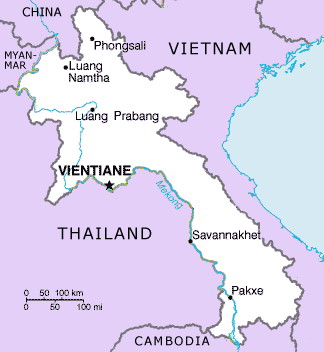 Laos is in Southeast Asia. Our neighbors are Thailand, Myanmar (also called Burma), China, Vietnam, and Cambodia. Laos is landlocked; we don't have direct access to the sea. In the past, transportation was usually by foot, or along the river. The network of paved roads is increasing, but many villages are still accessible only by traveling on the river, or by foot.
From an airplane, you'll see some fields of beautifully green rice. But most of Laos is mountainous.
How big is Laos?
The population is about 6.5 million. Half are under the age of 21. Many people belong to an ethnic group, or tribe. By the official government count, there are 49 such groups. Most of them have their own language, and many Lao children speak an ethnic language at home, then learn Lao when they enter school.
Geographically, Laos stretches over 236,000 square kilometers (90,000 square miles), about the size of Great Britain.
Is it called Laos, or Lao?
Up to you. In the Lao language, it's called "Lao" – Lao words never end with an "s" sound. In English, it is most often called "Laos", and you're more likely to be understood if you use that.
And officially, the full name is "Lao People's Democratic Republic", or "Lao PDR". But don't put that on a letter from the United States; the U.S. Post Office can't handle it and will return your letter. Just put "Laos".
What's the weather like? When is the best time to visit?
The cool season runs from November through February. The high temperatures are usually below 30 degrees Celsius, and evenings are cool enough that you'll often want long sleeves or a light jacket. It doesn't rain much at this time of year. Then the hot season rapidly arrives; in April and May the highs each day are 35 to 38 degrees. That's followed by four or five months of wet season, with each month getting a little cooler than the month before.
As for the best time to visit, that depends on your priorities. For the best weather, visit in the cool season, as every guidebook recommends. But that's also when things are busiest. In Luang Prabang, you should reserve a room in advance in December and January, and some restaurants fill up. Vientiane, with many government and NGO visitors, doesn't experience such big fluctuations in visitor levels.
So if you'd rather visit at a quieter time, consider the "wet season", particularly September and October. Usually it rains hard, but just for an hour or two a day. Then the sun comes out, and everything is greener than you ever thought possible.
If you come in April, you'll be hot, but you can enjoy Laos's biggest festival, the three-day New Year's celebration, in which people throw water on each other.
Where do people live? What do they do?
If you visit Luang Prabang or Vientiane, keep in mind that you're not seeing a typical part of Laos. About 80% of the population lives in rural villages, growing their own food – predominantly sticky rice, often with a few chickens, and a small vegetable garden. When we decide what books to publish at Big Brother Mouse, the first question we ask is whether the book would be suitable in one of these villages. Other criteria also enter into our decision, but that's a key one.
What language is spoken in Laos?
The official language is Lao. Many people speak an ethnic language at home. In these villages, older people often do not speak Lao, but children learn it when they start school.
Lao is similar to Thai. The most common words are often different, so a Lao person visiting Thailand would have difficulty being understood. But most of the vocabulary and grammar is similar or identical. Lao speakers with access to Thai television or radio typically pick up the language without consciously studying it.
What can I do to help?
Learn more about the country and culture, before you visit. Our page about Lao culture is a start, but only a start.
Visitors are often struck by the poverty they see, and respond in ways that make the visitor feel good, but
actually make the situation in Laos worse. Giving money to young people who approach you to "sponsor" them in school, or as a novice monk, rewards the most aggressive behavior, while doing nothing to help those who spend their time studying, repairing the temple, or meditating. It's better to donate to a temple, or to give a scholarship through the local college, which will choose a recipient based on merit and need, not on pushiness.
|