We regularly post pictures and news on Facebook, for both Big Brother Mouse, and Big Sister Mouse, in both English and Lao languages. Please search for those names, to see more recent news. Thank you!
June 2016
 New Ways to Learn
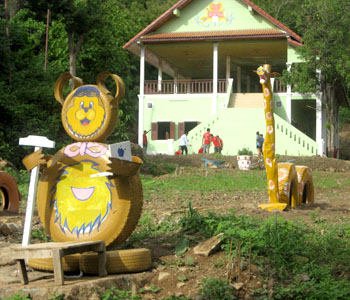
On June 8, our new Learning Center and Discovery World opened in Ban Nadaet, on the outskirts of Luang Prabang. We had some 200 guests for the first day, including village leaders, and lots of children. During the summer, we continue to have activities for children every day.
But we're doing much more. In September, we'll begin classes for older students, typically after they finish high school, with opportunities to learn in new ways -- through discussion, research, writing, and other alternatives to rote memorization.
Even sooner (on the first Monday of July), we're opening a 2-month summer school for children who can't read yet, or who don't read very well. It will have full-day classes, with an emphasis on fun ways to increase all sorts of skills, especially reading. We got considerable interest as soon as we announced it.
April 2016
 Big Brother Mouse wins IBBY-Asahi Reading Promotion Award
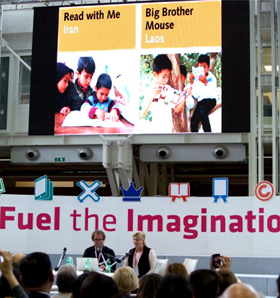
We are excited that Big Brother Mouse has been selected as one of two winners of the 2016 IBBY-Asahi Reading Promotion Award. This is given every two years by the International Board on Books for Young People, which considers nominations made by its members in 75 IBBY chapters worldwide. We are very honored and proud, and it will give us even more motivation to get our "Sustained Silent Reading" program into schools throughout Laos. Several of us will travel to the IBBY International Congress in August, in Auckland, to receive the award.
This photo shows the press conference where IBBY officials announced the winners. We also congratulate the other winner, Read With Me, based in Iran.
September 2015
 Did the cat really become a vegetarian Buddhist?
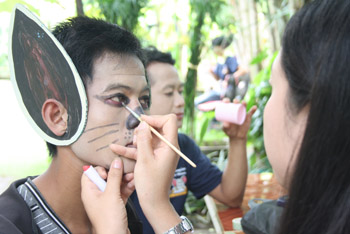
The mice would like to know. Unfortunately, they don't think to investigate until a bit too late. Siphone's collection of traditional Lao folktales, "The Cat That Meditated," was one of our very first books (49,000 copies in print!), and now it's our very first video. Characters speak in Lao sign language, and there's a background narration with spoken Lao. A big thank-you to the Global Fund for Children for making it possible.
We're ready to make more videos that include sign language. We need a sponsorship of $2,000 for the next one. Will you sponsor it? Please contact us if you have questions, or go ahead and donate, on the menu at left.
July 2015
 Does our daily reading program ("Sustained Silent Reading") make any difference? The short answer is: Yes, but...
We've completed our second evaluation of our daily reading program. We compared reading skiills improvements in 30 schools that got the program, with 15 schools that did not.
Last year's evaluation showed some impact but also highlighted two problems: The program did not help grades 1 and 2; and many teachers, although they had agreed to do it, didn't actually do so. They didn't think they should "just" let kids read. This year we addressed those problems, and tried again. We found on average that at schools with the program, reading skills improved 39% more than at those without it. And this year, with our new "I Can Read!" series, grades 1 and 2 benefited as much as the others. Details of this evaluation are available as a PDF, please click for Evaluation Report 2014-15: Sustained Silent Reading in Laos
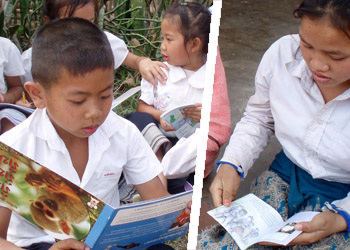
Please DO try this at home, but your percentage increase may be less impressive. We're starting from a very low base. Reading levels are lower, and books are rarer, than you might imagine. These two students are holding their books upside down, and don't seem to have realized it yet.
April 2015
 "Education is not the filling of a pail, but the lighting of a fire." Surely we would all find some truth in that proverb (while also recognizing that there's nothing wrong with full buckets).
For two years, we've been planning our new Discovery World and Learning Center, to be built on 3 hectares (8 acres) on the outskirs of Luang Prabang. This month, after a baci ceremony to bless the land, construction began.
This is several inter-related projects: A small library; a set of hands-on, interactive educational activities; and a center for longer-term learning. We invite you to read full details:
Discovery World and Learning Center and then, please consider becoming a Founder.
March 2015
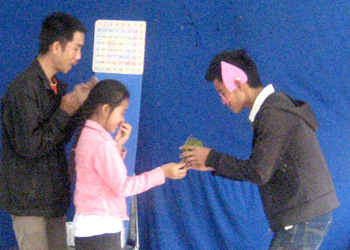 Many deaf children in rural Lao villages have no way to learn language at all. We're developing ways to help them, and their classmates, learn sign language so they can communicate. Here's one.
This skit is based on the popular Lao folktale, "The Cat That Meditated." A cat promises to behave better, stop eating mice, and only eat vegetables. In return, the mice promise to bring fresh vegetables to the cat every day. Two deaf members of our staff play the role of cat and the lead mouse. They have a conversation in sign language, while someone else reads aloud, in Lao, what they are saying. Volunteers from the audience play walk-on roles as mice who deliver fresh lettuce to the cat.
In this scene, a little mouse brings the cat his food. Soon after, in the climax of the play, the good-for-nothing, two-timing, fur-faced, not-gonna-go-to-heaven-after-all cat scornfully tosses the lettuce aside and eats the mouse. This brings down the house.
Even this small production, however, highlighted some of the difficulties we'll face. Suliphone (left) can read simple Lao, but he mis-read one word and at first used the sign for "decide" instead of "meditate". Sali (right) reads much less, and didn't understand the concept of acting. But after three days of rehearsal, we were able to do this performance; then he saw the point. Afterwards, we repeated the skit, but with the whole audience joining to do the signs.
February 2015
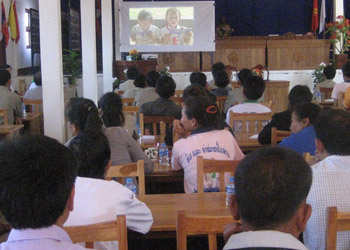 Seven-year-old children!!! Reading aloud!!! It's hard to believe -- see it on the video!!!
In the past two years we've developed a daily reading program, made changes based on classroom experience, and conducted evaluations to show that it really does improve reading skills. Now the challenge is: Getting teachers to believe it helps.
Teachers in Laos grew up with a teacher-and-blackboard system, and they aren't convinced that anything else will work. Sometimes, instead of following a program that is different from what they know, they revert to habit.
With support from the Global Fund for Children, we've developed our video skills, and we put them to use: At a teacher workshop we showed a video of 7-year-old children reading aloud!!! Where you live, that might not earn so many exclamation points. But here, it's widely accepted that children won't learn to read until grade 3, or later. The video is one of several approaches we're using to show teachers that our "Sustained Silent Reading" program really works.
Archived News from 2006-2007.
From 2008.
From 2009.
From 2010.
From 2011.
From 2012.
From 2013.
From 2014.