|
Coming to Luang Prabang? You don't need to bring anything! We're happy for you to just come and see what we're doing. We especially invite you to spend a day volunteering at our Big Sister Mouse school in the countryside (we'll provide transportation and lunch), where you'll enjoy games and conversation with students of many ages, while helping them practice English.
However, visitors sometimes ask if they can bring anything, so here's our list. It is not important that items be new. Things thrown out in the West can be put to good use here. If you're coming to Laos, a notice in your church, temple, or community center might produce someone willing to donate one of these items which they no longer need.
Educational Toys
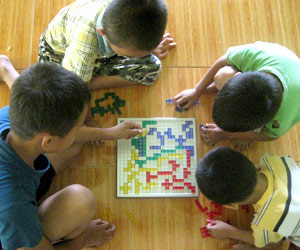 At our school, Big Sister Mouse, we're developing ways to improve education with a hands-on approach, something that's rare here. We spend considerable time and effort to give our staff, and other young people, the types of interactive learning experiences that are taken for granted in the west, but are still rare here. That includes opportunities to learn new things, and simply to play in ways that stimulate creativity. The following items are what we most welcome: At our school, Big Sister Mouse, we're developing ways to improve education with a hands-on approach, something that's rare here. We spend considerable time and effort to give our staff, and other young people, the types of interactive learning experiences that are taken for granted in the west, but are still rare here. That includes opportunities to learn new things, and simply to play in ways that stimulate creativity. The following items are what we most welcome:
* Games that involve thinking and strategy. We're able to buy chess and Monopoly sets in Thailand, but little else is available. We'd very much like to get board games such as Clue, Stratego, and Risk; and others such as Word Dominoes.
* Specific toys that encourage creativity and help learning. These are: K'Nex, K'Nex for Kids, Zoob, Legos and Duplo blocks; and Lincoln Logs.
* Other educational toys. Walk into the gift shop of a big museum, and you'll probably find an interesting array of toys and games that have an educational value. We need toys and items like these: a microscope, prisms, anatomical models, small items for science experiments, sample rocks, minerals, and fossils, simple games that require various types of reasoning, thinking, or spatial logic, "Magnatiles", "Tensegritoy," anything that helps children and young adults to see things in a new way is educational. Used items from your family, or your friends, are fine. Do you have a View-Master, which lets you see pictures in 3-D, that has fallen out of use? (We already have View-Master disks, but the View-Masters themselves have been used until they've fallen apart.)
* Pre-school toys. Our school includes children ages 3 to 5, who benefit from the same types of hard-to-break, impossible-to-swallow toys as do kids everywhere.
Books
We need the educational toys and items, described above, much more than we need English-language books. If you want to bring books, here are some guidelines:
* Easy, interesting non-fiction. We have many English picture books and story books. What we need most are non-fiction books which (1) are written on about a 1st to 6th grade level, with simple words; and (2) the subject and approach are interesting. Subjects can range widely: nature, (animals, plants, the solar system), history (esp. but not only ancient history and cultures), health, numbers, biographies of significant people in Asia. Anything with a focus on Asia is especially good.
* Your favorite book. We don't need large quantities of books. But if you particularly loved one book as a child, or a child you know has a special favorite, we'd welcome a copy. We use these for inspiration by our staff. When you arrive, ask if there's an opportunity to talk with some of the staff about what makes this book special.
Equipment
* Used laptops. Many people have an old laptop in the closet that works fine, but never gets used. We can use it! We don't need the lastest thing, often we run on Windows XP. A minimum 256 MB of RAM, a working CD drive, and at least 2 USB ports, are the main requirements. It's even OK if the battery is dead, we can keep it plugged in.
* Used digital cameras. Do you have an old camera in a drawer? We don't need lots of pixels, just something that works, with a memory card that fits. If you don't have the cables, memory cards, or manuals, no problem: We have a good assortment of those items.
|